
- Product category
-
Human cells
- Organism
-
Homo sapiens, human
- Cell type
- T lymphoblast
- Morphology
- lymphoblast
- Tissue
- Peripheral blood
- Disease
-
Acute lymphoblastic leukemia ALL
- Applications
-
3D cell cultureImmune system disorder researchImmunology
- Product format
- Frozen
- Storage conditions
-
Vapor phase of liquid nitrogen
Documentation

ATCC determines the biosafety level of a material based on our risk assessment as guided by the current edition of Biosafety in Microbiological and Biomedical Laboratories (BMBL), U.S. Department of Health and Human Services. It is your responsibility to understand the hazards associated with the material per your organization’s policies and procedures as well as any other applicable regulations as enforced by your local or national agencies.
ATCC highly recommends that appropriate personal protective equipment is always used when handling vials. For cultures that require storage in liquid nitrogen, it is important to note that some vials may leak when submersed in liquid nitrogen and will slowly fill with liquid nitrogen. Upon thawing, the conversion of the liquid nitrogen back to its gas phase may result in the vial exploding or blowing off its cap with dangerous force creating flying debris. Unless necessary, ATCC recommends that these cultures be stored in the vapor phase of liquid nitrogen rather than submersed in liquid nitrogen.
Detailed product information
General
- Specific applications
-
This cell line is a suitable transfection host.
Characteristics
- Growth properties
- Suspension
- Derivation
- Human lymphoblasts from peripheral blood of a child with acute leukemia.
- Age
- 4 years
- Ethnicity
- White
- Sex
- Female
- Karyotype
-
modal number = 47; range = 41 to 95.
Fifty karyotypes showed no consistent loss or gain of particular chromosomes. Twenty-eight percent of the cells with 45 chromosomes were C-; 53% of all cells had an extra D and 35% had an extra F. Only N1 and N18 were not affected by gain or loss. No marker chromosomes noted. - Tumorigenic
-
Yes; Yes, in syrian hamstersRefAdams RA, et al. Leukemia: serial transplantation of human leukemic lymphoblasts in the newborn Syrian hamster. Cancer Res. 27: 772-783, 1967. PubMed: 4295047
- Antigen expression
-
CD3; Homo sapiens, expressedCD4; Homo sapiens, expressedCD5; Homo sapiens, expressedCD7; Homo sapiens, expressed
- Genes expressed
- CD3; CD5; CD7; CD4
- Isoenzymes
-
ADA, 1ES-D, 1G6PD, BGLO-I, 1PEP-D, 1PGD, CPGM1, 1PGM3, 0
- Technical information
-
ATCC Product Experience does not have technical information on patent deposits that are not produced or characterized by ATCC. Additional information can be found in the corresponding patent available from the patent holder or with the U.S. and/or international patent office.
Handling information
- Unpacking and storage instructions
-
- Check all containers for leakage or breakage.
- Remove the frozen cells from the dry ice packaging and immediately place the cells at a temperature below -130°C, preferably in liquid nitrogen vapor, until ready for use.
- Complete medium
- The base medium for this cell line is ATCC-formulated RPMI-1640 Medium, ATCC 30-2001. To make the complete growth medium, add the following components to the base medium: fetal bovine serum (ATCC 30-2020) to a final concentration of 10%.
- Temperature
-
37°C
- Handling procedure
-
To insure the highest level of viability, thaw the vial and initiate the culture as soon as possible upon receipt. If upon arrival, continued storage of the frozen culture is necessary, it should be stored in liquid nitrogen vapor phase and not at -70°C. Storage at -70°C will result in loss of viability.
- Thaw the vial by gentle agitation in a 37°C water bath. To reduce the possibility of contamination, keep the O-ring and cap out of the water. Thawing should be rapid (approximately 2 minutes).
- Remove the vial from the water bath as soon as the contents are thawed, and decontaminate by dipping in or spraying with 70% ethanol. All of the operations from this point on should be carried out under strict aseptic conditions.
- It is recommended that the cryoprotective agent be removed immediately. Centrifuge the cell suspension at approximately 125 x g for 5 to 10 minutes.
- Transfer the cell pellet to an appropriate size vessel(see the specific batch information for the culture recommended dilution ratio). It is important to avoid excessive alkalinity of the medium during recovery of the cells. It is suggested that, prior to the addition of the vial contents, the culture vessel containing the growth medium be placed into the incubator for at least 15 minutes to allow the medium to reach its normal pH (7.0 to 7.6).
- Incubate the culture at 37°C in a suitable incubator. A 5% CO2 in air atmosphere is recommended if using the medium described on this product sheet.
- Subculturing procedure
-
Cultures can be maintained by the addition of fresh medium or replacement of medium. Maintain density from 1.0 x 10⁵ to 2.0 x 10⁶ viable cells/mL.Medium Renewal: Add fresh medium (20% to 30% by volume) every 2 to 3 days
- Reagents for cryopreservation
- Complete growth medium supplemented with 7.5% (v/v) DMSO (ATCC 4-X)
Quality control specifications
- Mycoplasma contamination
- Not detected
- STR profiling
- Amelogenin: X CSF1PO: 10,11 D13S317: 11,12 D16S539: 10,13 D5S818: 12,13 D7S820: 9,13 TH01: 6,7 TPOX: 8 vWA: 17,19 D3S1358: 15 D21S11: 30,33.2 D18S51: 13,18 Penta_E: 5,14 Penta_D: 11 D8S1179: 13 FGA: 23,24 D19S433: 14,15 D2S1338: 24
History
- Deposited as
- Homo sapiens
- Depositors
- GE Foley
- Year of origin
- 1964
- Cross references
-
GenBank Z23090 H.sapiens mRNA for 28 kDa heat shock protein.GenBank AF146431 Homo sapiens cell-line CCRF-CEM sodium/hydrogen exchanger isoform 1 mRNA, complete cds.GenBank Z12846 HSA08C081 CLONTECH cDNA library CCRF-CEM, cat# HL1063g Homo sapiens cDNA clone 08C08, mRNA sequence.GenBank Z13104 HSA25H071 CLONTECH cDNA library CCRF-CEM, cat# HL1063g Homo sapiens cDNA clone 25H07, mRNA sequence.GenBank Z13398 HSA45A081 CLONTECH cDNA library CCRF-CEM, cat# HL1063g Homo sapiens cDNA clone 45A08, mRNA sequence.GenBank Z13431 HSA48B021 CLONTECH cDNA library CCRF-CEM, cat# HL1063g Homo sapiens cDNA clone 48B02, mRNA sequence.GenBank Z13562 HSA57F051 CLONTECH cDNA library CCRF-CEM, cat# HL1063g Homo sapiens cDNA clone 57F05, mRNA sequence.GenBank Z13677 HSA65D041 CLONTECH cDNA library CCRF-CEM, cat# HL1063g Homo sapiens cDNA clone 65D04, mRNA sequence.GenBank Z13711 HSA68F071 CLONTECH cDNA library CCRF-CEM, cat# HL1063g Homo sapiens cDNA clone 68F07, mRNA sequence.GenBank Z13717 HSA69C041 CLONTECH cDNA library CCRF-CEM, cat# HL1063g Homo sapiens cDNA clone 69C04, mRNA sequence.GenBank Z15500 HSA23D012 CLONTECH cDNA library CCRF-CEM, cat# HL1063g Homo sapiens cDNA clone 23D01, mRNA sequence.GenBank Z15555 HSA27A032 CLONTECH cDNA library CCRF-CEM, cat# HL1063g Homo sapiens cDNA clone 27A03, mRNA sequence.GenBank Z16011 HSA56G072 CLONTECH cDNA library CCRF-CEM, cat# HL1063g Homo sapiens cDNA clone 56G07, mRNA sequence.
Legal disclaimers
- Intended use
- This product is intended for laboratory research use only. It is not intended for any animal or human therapeutic use, any human or animal consumption, or any diagnostic use.
- Warranty
-
The product is provided 'AS IS' and the viability of ATCC® products is warranted for 30 days from the date of shipment, provided that the customer has stored and handled the product according to the information included on the product information sheet, website, and Certificate of Analysis. For living cultures, ATCC lists the media formulation and reagents that have been found to be effective for the product. While other unspecified media and reagents may also produce satisfactory results, a change in the ATCC and/or depositor-recommended protocols may affect the recovery, growth, and/or function of the product. If an alternative medium formulation or reagent is used, the ATCC warranty for viability is no longer valid. Except as expressly set forth herein, no other warranties of any kind are provided, express or implied, including, but not limited to, any implied warranties of merchantability, fitness for a particular purpose, manufacture according to cGMP standards, typicality, safety, accuracy, and/or noninfringement.
- Disclaimers
-
This product is intended for laboratory research use only. It is not intended for any animal or human therapeutic use, any human or animal consumption, or any diagnostic use. Any proposed commercial use is prohibited without a license from ATCC.
While ATCC uses reasonable efforts to include accurate and up-to-date information on this product sheet, ATCC makes no warranties or representations as to its accuracy. Citations from scientific literature and patents are provided for informational purposes only. ATCC does not warrant that such information has been confirmed to be accurate or complete and the customer bears the sole responsibility of confirming the accuracy and completeness of any such information.
This product is sent on the condition that the customer is responsible for and assumes all risk and responsibility in connection with the receipt, handling, storage, disposal, and use of the ATCC product including without limitation taking all appropriate safety and handling precautions to minimize health or environmental risk. As a condition of receiving the material, the customer agrees that any activity undertaken with the ATCC product and any progeny or modifications will be conducted in compliance with all applicable laws, regulations, and guidelines. This product is provided 'AS IS' with no representations or warranties whatsoever except as expressly set forth herein and in no event shall ATCC, its parents, subsidiaries, directors, officers, agents, employees, assigns, successors, and affiliates be liable for indirect, special, incidental, or consequential damages of any kind in connection with or arising out of the customer's use of the product. While reasonable effort is made to ensure authenticity and reliability of materials on deposit, ATCC is not liable for damages arising from the misidentification or misrepresentation of such materials.
Please see the material transfer agreement (MTA) for further details regarding the use of this product. The MTA is available at www.atcc.org.
- Disclosures
-
This material is cited in a US and/or international patent and may not be used to infringe the claims. Depending on the wishes of the Depositor, ATCC may be required to inform the Depositor of the party to which the material was furnished.
Images
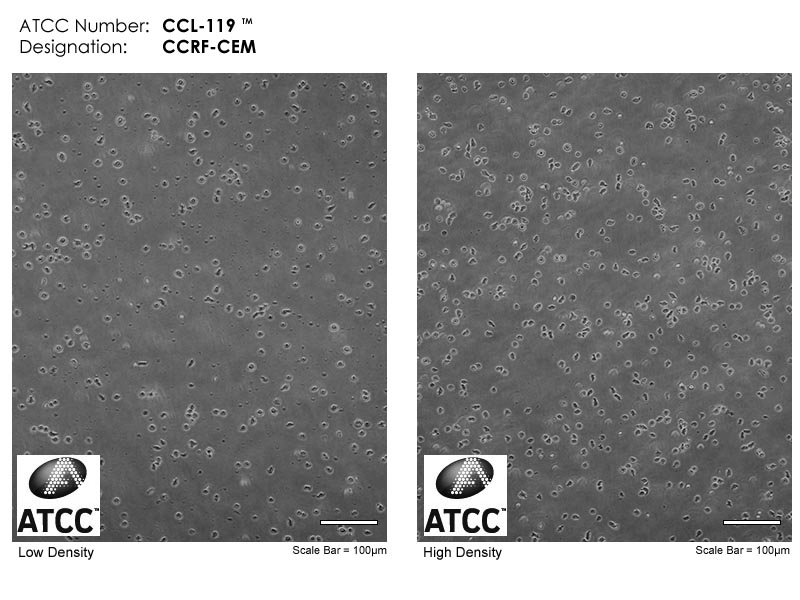
Frequently Asked Questions
References
Curated Citations
Foley GE, et al. Continous culture of human lymphoblasts from peripheral blood of a child with acute leukemia. Cancer 18: 522-529, 1965. PubMed: 14278051
Sandstrom PA, Buttke TM. Autocrine production of extracellular catalase prevents apoptosis of the human CEM T-cell line in serum-free medium. Proc. Natl. Acad. Sci. USA 90: 4708-4712, 1993. PubMed: 8506323
Adams RA. Formal discussion: the role of transplantation in the experimental investigation of human leukemia and lymphoma. Cancer Res. 27: 2479-2482, 1967. PubMed: 4170381
Uzman BG, et al. Morphologic variations in human leukemic lymphoblasts (CCRF-CEM cells) after long-term culture and exposure to chemotherapeutic agents. A study with the electron microscope. Cancer 19: 1725-1742, 1966. PubMed: 5224274
Adams RA, et al. Leukemia: serial transplantation of human leukemic lymphoblasts in the newborn Syrian hamster. Cancer Res. 27: 772-783, 1967. PubMed: 4295047
 Powered by Bioz
For product-related inquiries and issues, contact Product Experience:


Hours of Operation
US Eastern Time
