
- Product category
-
Human cells
- Product type
-
Cell model
- Organism
-
Homo sapiens, human
- Cell type
- erythroblast
- Morphology
- lymphoblast
- Tissue
- Bone; Marrow
- Disease
-
Erythroleukemia
- Applications
-
3D cell cultureAssay developmentDrug developmentDrug resistanceHigh-throughput screeningImmune system disorder researchImmunology
- Product format
- Frozen
- Storage conditions
-
Vapor phase of liquid nitrogen
Documentation

ATCC determines the biosafety level of a material based on our risk assessment as guided by the current edition of Biosafety in Microbiological and Biomedical Laboratories (BMBL), U.S. Department of Health and Human Services. It is your responsibility to understand the hazards associated with the material per your organization’s policies and procedures as well as any other applicable regulations as enforced by your local or national agencies.
Cells contain cytomegalovirus (CMV) DNA sequences
Cells contain SV40 sequences
ATCC highly recommends that appropriate personal protective equipment is always used when handling vials. For cultures that require storage in liquid nitrogen, it is important to note that some vials may leak when submersed in liquid nitrogen and will slowly fill with liquid nitrogen. Upon thawing, the conversion of the liquid nitrogen back to its gas phase may result in the vial exploding or blowing off its cap with dangerous force creating flying debris. Unless necessary, ATCC recommends that these cultures be stored in the vapor phase of liquid nitrogen rather than submersed in liquid nitrogen.
Detailed product information
General
- Specific applications
- Tumor-associated mutant IDH2R140Q, isocitrate dehydrogenase-2, IDH2 mutant, acute myeloid leukemia (AML) patients, anti-cancer drug screening, IDH2-specific inhibitors.
Characteristics
- Cells per vial
- ≥ 1.0 x 10⁶
- Growth properties
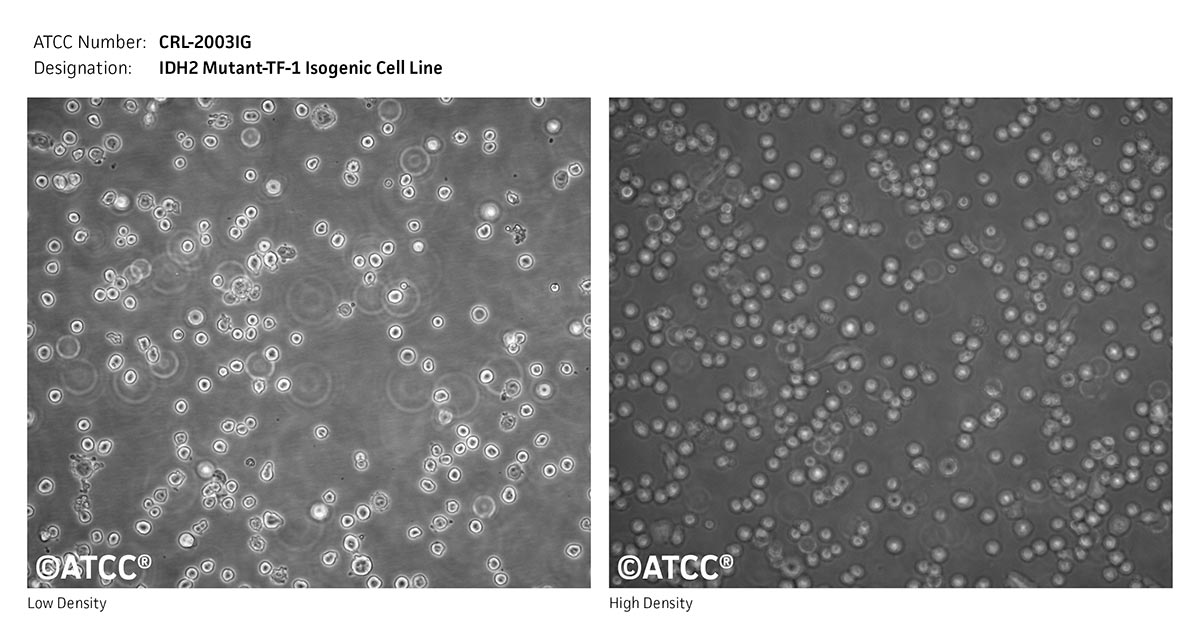
- Suspension
- Age
- 35 years
- Ethnicity
- Asian
- Sex
- Male
- Comments
-
This is an acute myeloid leukemia (AML) IDH2R140Q mutant isogenic line derived from the parental TF-1 cell line. The c.419G>A knock-in mutation encoding IDH2R140Q protein expression was generated at ATCC by utilizing the CRISPR/Cas9 gene editing technology. This is a homozygous mutation expressing the c.419G>A mutant allele. The IDH2R140Q mutation in CRL-2003IG has been validated at the genomic, transcript, and protein bio-functional levels.
The IDH2R140Q mutation is a cancer driver gene which causes a gain of function in tumor cells converting isocitrate to the oncometabolite, D-2-hydroxyglutarate (D-2HG). High intracellular levels of D-2HG inhibits alpha-ketoglutarate-dependent DNA and histone demethylases, resulting in epigenetic disregulation, which in turn leads to a block in cellular differentiation, promoting AML development. These effects are reduced with treatment of IDH2 mutant-specific small-molecule inhibitors such as AG-221.
The IDH2R140Q mutant isogenic line CRL-2003IG has been tested for neomorphic functional activity displaying elevated intra- and extracellular D-2HG levels. A reduction in histone hypermethylation was also observed upon treatment with IDH2 specific molecules, AG-221 and AGI-6780. This IDH2R140Q isogenic cell model is a valuable in vitro cell-based tool for clinical diagnostics, elucidating mechanisms involved in cancer-associated differentiation, tumorigenesis and use in screening anti-cancer compounds for drug discovery and development.
Refer to the TF-1 parental line (ATCC CRL-2003) for additional background information.
Handling information
- Unpacking and storage instructions
-
- Check all containers for leakage or breakage.
- Remove the frozen cells from the dry ice packaging and immediately place the cells at a temperature below -130°C, preferably in liquid nitrogen vapor, until ready for use.
- Complete medium
-
The base medium for this cell line is RPMI-1640 Medium (ATCC 30-2001). To make the complete growth medium, add the following components to the base medium:
- 2 ng/ml recombinant human GM-CSF
- Fetal Bovine Serum (FBS; ATCC 30-2020) to a final concentration of 10%
- Temperature
-
37°C
- Atmosphere
-
95% Air, 5% CO2
- Handling procedure
-
To insure the highest level of viability, thaw the vial and initiate the culture as soon as possible upon receipt. If upon arrival, continued storage of the frozen culture is necessary, it should be stored in liquid nitrogen vapor phase and not at -70°C. Storage at -70°C will result in loss of viability.
- Thaw the vial by gentle agitation in a 37°C water bath. To reduce the possibility of contamination, keep the O-ring and cap out of the water. Thawing should be rapid (approximately 2 minutes).
- Remove the vial from the water bath as soon as the contents are thawed, and decontaminate by dipping in or spraying with 70% ethanol. All of the operations from this point on should be carried out under strict aseptic conditions.
- Transfer the vial contents to a centrifuge tube containing 9.0 mL complete culture medium and spin at approximately 150 x g for 5 to 7 minutes.
- Resuspend cell pellet with the recommended complete medium (see the specific batch information for the culture recommended dilution ratio) and dispense into a 25 cm2 or a 75 cm2 culture flask. It is important to avoid excessive alkalinity of the medium during recovery of the cells. It is suggested that, prior to the addition of the vial contents, the culture vessel containing the complete growth medium be placed into the incubator for at least 15 minutes to allow the medium to reach its normal pH (7.0 to 7.6).
- Incubate the culture at 37°C in a suitable incubator. A 5% CO2 in air atmosphere is recommended if using the medium described on this product sheet.
- Subculturing procedure
-
Cultures can be maintained by addition or replacement of fresh medium. Start cultures at 8 X 10⁴ cells/mL and maintain between 5 X 10⁴ and 1 X 10⁶ cells/mL.
Medium Renewal: Add fresh medium every 2 to 3 days (depending on cell density).
Quality control specifications
- Bacterial and fungal testing
- Not detected
- Mycoplasma contamination
- Not detected
- Virus testing
-
Cytomegalovirus (CMV): Not detectedHuman papillomavirus (HPV): Not detectedHuman Immunodeficiency virus (HIV): Not detectedEpstein-Barr virus (EBV): Not detectedHepatitis B virus (HBV): Not detected
- Functional tests
- Interleukin 3 (IL-3) independent proliferation assay; intracellular and extracelluylar D-2-hydroxyglutarate (D-2HG) measurement, histone hypermethylation levels
- Population doubling time
- Approximately 24.8 hrs
- STR profiling
-
Amelogenin: X,YCSF1PO: 13D13S317: 8,9D16S539: 9,12D5S818: 13D7S820: 12TH01: 7,9TPOX: 8vWA: 15,17
History
- Patent number
-
For‑profit customers intending to use this product for non-commercial screening must include the one-time “ATCC Screening Fee” (ATCC ACS‑2103F) with their first purchase of this product.
- Year of origin
- 2016
Legal disclaimers
- Intended use
- This product is intended for laboratory research use only. It is not intended for any animal or human therapeutic use, any human or animal consumption, or any diagnostic use.
- Warranty
-
The product is provided 'AS IS' and the viability of ATCC® products is warranted for 30 days from the date of shipment, provided that the customer has stored and handled the product according to the information included on the product information sheet, website, and Certificate of Analysis. For living cultures, ATCC lists the media formulation and reagents that have been found to be effective for the product. While other unspecified media and reagents may also produce satisfactory results, a change in the ATCC and/or depositor-recommended protocols may affect the recovery, growth, and/or function of the product. If an alternative medium formulation or reagent is used, the ATCC warranty for viability is no longer valid. Except as expressly set forth herein, no other warranties of any kind are provided, express or implied, including, but not limited to, any implied warranties of merchantability, fitness for a particular purpose, manufacture according to cGMP standards, typicality, safety, accuracy, and/or noninfringement.
- Disclaimers
-
This product is intended for laboratory research use only. It is not intended for any animal or human therapeutic use, any human or animal consumption, or any diagnostic use. Any proposed commercial use is prohibited without a license from ATCC.
While ATCC uses reasonable efforts to include accurate and up-to-date information on this product sheet, ATCC makes no warranties or representations as to its accuracy. Citations from scientific literature and patents are provided for informational purposes only. ATCC does not warrant that such information has been confirmed to be accurate or complete and the customer bears the sole responsibility of confirming the accuracy and completeness of any such information.
This product is sent on the condition that the customer is responsible for and assumes all risk and responsibility in connection with the receipt, handling, storage, disposal, and use of the ATCC product including without limitation taking all appropriate safety and handling precautions to minimize health or environmental risk. As a condition of receiving the material, the customer agrees that any activity undertaken with the ATCC product and any progeny or modifications will be conducted in compliance with all applicable laws, regulations, and guidelines. This product is provided 'AS IS' with no representations or warranties whatsoever except as expressly set forth herein and in no event shall ATCC, its parents, subsidiaries, directors, officers, agents, employees, assigns, successors, and affiliates be liable for indirect, special, incidental, or consequential damages of any kind in connection with or arising out of the customer's use of the product. While reasonable effort is made to ensure authenticity and reliability of materials on deposit, ATCC is not liable for damages arising from the misidentification or misrepresentation of such materials.
Please see the material transfer agreement (MTA) for further details regarding the use of this product. The MTA is available at www.atcc.org.
Images


Frequently Asked Questions
References
Curated Citations
Kroeze LI, et al. Characterization of acute myeloid leukemia based on levels of global hydroxymethylation. Blood 124(7): 1110-1118, 2014. PubMed: 24986689
Wang F, et al. Targeted inhibition of mutant IDH2 in leukemia cells induces cellular differentiation. Science 340(6132): 622-626, 2013. PubMed: 23558173
Ward PS, et al. The common feature of leukemia-associated IDH1 and IDH2 mutations is a neomorphic enzyme activity converting alpha-ketoglutarate to 2-hydroxyglutarate. Canc Cell 18(3): 225-234, 2010. PubMed: 20171147
Figueroa ME, et al. Leukemic IDH1 and IDH2 mutations result in a hypermethylation phenotype, disrupt TET2 function, and impair hematopoietic differentiation. Canc Cell 18(6): 553-567, 2010. PubMed: 21130701
 Powered by Bioz
For product-related inquiries and issues, contact Product Experience:


Hours of Operation
US Eastern Time
