
- Product category
-
Human cells
- Organism
-
Homo sapiens, human
- Morphology
- epithelial
- Tissue
- kidney
- Disease
-
Clear cell Carcinoma
- Applications
-
3D cell cultureCancer researchHigh-throughput screeningToxicology
- Product format
- Frozen
- Storage conditions
-
Vapor phase of liquid nitrogen
Documentation

ATCC determines the biosafety level of a material based on our risk assessment as guided by the current edition of Biosafety in Microbiological and Biomedical Laboratories (BMBL), U.S. Department of Health and Human Services. It is your responsibility to understand the hazards associated with the material per your organization’s policies and procedures as well as any other applicable regulations as enforced by your local or national agencies.
ATCC highly recommends that appropriate personal protective equipment is always used when handling vials. For cultures that require storage in liquid nitrogen, it is important to note that some vials may leak when submersed in liquid nitrogen and will slowly fill with liquid nitrogen. Upon thawing, the conversion of the liquid nitrogen back to its gas phase may result in the vial exploding or blowing off its cap with dangerous force creating flying debris. Unless necessary, ATCC recommends that these cultures be stored in the vapor phase of liquid nitrogen rather than submersed in liquid nitrogen.
Detailed product information
General
- Specific applications
-
This cell line is a suitable transfection host.
Characteristics
- Growth properties
- Adherent
- Derivation
- Caki-1 was derived from a human tumor.
- Age
- 49 years
- Ethnicity
- White
- Sex
- Male
- Karyotype
-
modal number = 68; range = 63 to 71.
The cell line is aneuploid human, with chromosome counts in the triploid range. The Y chromosome is absent; however, loss of the Y chromosome is not unusual from male tumor cell lines. All normal autosomes except chromosome N9 and N19 are represented, usually by two or three copies. Chromosome N9 is recognized as a marker chromosome (M1) that is usually trisomic. Normal chromosome N5 is and chromosomes N10 and N16 tend to be over-represented with respect to the copy number of other normal chromosomes. Thirteen marker chromosomes are identified: 9q+, t(1p;?), t(1qter>1q21::20), t(1q17q), der(11)t(3;11)(q21;q14), 19q+, 4q+, 4p+ and others. The chromosome counts and general cytogenetic features are in keeping with those described by J. Fogh, et al., J. Natl. Cancer Inst. (Bethesda) 58: 209, 1977. - Tumorigenic
-
Yes; Yes, in nude mice; forms clear cell carcinoma in nude mice consistent with renal primary; also forms tumors in steroid treated hamsters
- Metastatic
- Skin
- Antigen expression
- Blood Type O; Rh-; HLA A9, B12, Bw35
- Isoenzymes
-
AK-1, 1ES-D, 1-2G6PD, BGLO-I, 1-2Me-2, 2PGM1, 1PGM3, 1-2
- Comments
- Ultrastructural features include many microvilli, few filaments, many small mitochondria, well developed Golgi and ER, many lipid droplets and multilaminate bodies, secondary lysosomes, no virus particles.
Handling information
- Unpacking and storage instructions
-
- Check all containers for leakage or breakage.
- Remove the frozen cells from the dry ice packaging and immediately place the cells at a temperature below -130°C, preferably in liquid nitrogen vapor, until ready for use.
- Complete medium
- The base medium for this cell line is ATCC-formulated McCoy's 5a Medium Modified, Catalog No. 30-2007. To make the complete growth medium, add the following components to the base medium: fetal bovine serum to a final concentration of 10%.
- Temperature
-
37°C
- Handling procedure
-
To insure the highest level of viability, thaw the vial and initiate the culture as soon as possible upon receipt. If upon arrival, continued storage of the frozen culture is necessary, it should be stored in liquid nitrogen vapor phase and not at -70°C. Storage at -70°C will result in loss of viability.
- Thaw the vial by gentle agitation in a 37°C water bath. To reduce the possibility of contamination, keep the O-ring and cap out of the water. Thawing should be rapid (approximately 2 minutes).
- Remove the vial from the water bath as soon as the contents are thawed, and decontaminate by dipping in or spraying with 70% ethanol. All of the operations from this point on should be carried out under strict aseptic conditions.
- Transfer the vial contents to a 75 cm2 tissue culture flask and dilute with the recommended complete culture medium (see the specific batch information for the recommended dilution ratio). It is important to avoid excessive alkalinity of the medium during recovery of the cells. It is suggested that, prior to the addition of the vial contents, the culture vessel containing the growth medium be placed into the incubator for at least 15 minutes to allow the medium to reach its normal pH (7.0 to 7.6).
- Incubate the culture at 37°C in a suitable incubator. A 5% CO2 in air atmosphere is recommended if using the medium described on this product sheet.
If it is desired that the cryoprotective agent be removed immediately, or that a more concentrated cell suspension be obtained, centrifuge the cell suspension at approximately 125 xg for 5 to 10 minutes. Discard the supernatant and resuspend the cells with fresh growth medium at the dilution ratio recommended in the specific batch information.
- Subculturing procedure
-
- Remove and discard culture medium.
- Briefly rinse the cell layer with 0.25% (w/v) Trypsin- 0.53 mM EDTA solution to remove all traces of serum that contains trypsin inhibitor.
- Add 2.0 to 3.0 ml of Trypsin-EDTA solution to flask and observe cells under an inverted microscope until cell layer is dispersed (usually within 5 to 15 minutes).
Note: To avoid clumping do not agitate the cells by hitting or shaking the flask while waiting for the cells to detach. Cells that are difficult to detach may be placed at 37°C to facilitate dispersal. - Add 6.0 to 8.0 ml of complete growth medium and aspirate cells by gently pipetting.
- Add appropriate aliquots of the cell suspension to new culture vessels.
- Incubate cultures at 37°C.
Subcultivation Ratio: A subcultivation ratio of 1:2 to 1:4 is recommendedMedium Renewal: 2 to 3 times per week - Reagents for cryopreservation
- Complete growth medium supplemented with 5% (v/v) DMSO (ATCC 4-X)
Quality control specifications
- Mycoplasma contamination
- Not detected
- STR profiling
- Amelogenin: X CSF1PO: 10,11 D13S317: 11,12 D16S539: 12 D5S818: 11,12 D7S820: 8,12 TH01: 6,8 TPOX: 8,11 vWA: 15,17 D3S1358: 17 D21S11: 28,30 D18S51: 14 Penta_E: 11,22,23 Penta_D: 11,12 D8S1179: 12,14 FGA: 26 D19S433: 14 D2S1338: 17,19
History
- Deposited as
- Homo sapiens
- Depositors
- J Fogh
- Special collection
-
Human Tumor Cell Bank
Legal disclaimers
- Intended use
- This product is intended for laboratory research use only. It is not intended for any animal or human therapeutic use, any human or animal consumption, or any diagnostic use.
- Warranty
-
The product is provided 'AS IS' and the viability of ATCC® products is warranted for 30 days from the date of shipment, provided that the customer has stored and handled the product according to the information included on the product information sheet, website, and Certificate of Analysis. For living cultures, ATCC lists the media formulation and reagents that have been found to be effective for the product. While other unspecified media and reagents may also produce satisfactory results, a change in the ATCC and/or depositor-recommended protocols may affect the recovery, growth, and/or function of the product. If an alternative medium formulation or reagent is used, the ATCC warranty for viability is no longer valid. Except as expressly set forth herein, no other warranties of any kind are provided, express or implied, including, but not limited to, any implied warranties of merchantability, fitness for a particular purpose, manufacture according to cGMP standards, typicality, safety, accuracy, and/or noninfringement.
- Disclaimers
-
This product is intended for laboratory research use only. It is not intended for any animal or human therapeutic use, any human or animal consumption, or any diagnostic use. Any proposed commercial use is prohibited without a license from ATCC.
While ATCC uses reasonable efforts to include accurate and up-to-date information on this product sheet, ATCC makes no warranties or representations as to its accuracy. Citations from scientific literature and patents are provided for informational purposes only. ATCC does not warrant that such information has been confirmed to be accurate or complete and the customer bears the sole responsibility of confirming the accuracy and completeness of any such information.
This product is sent on the condition that the customer is responsible for and assumes all risk and responsibility in connection with the receipt, handling, storage, disposal, and use of the ATCC product including without limitation taking all appropriate safety and handling precautions to minimize health or environmental risk. As a condition of receiving the material, the customer agrees that any activity undertaken with the ATCC product and any progeny or modifications will be conducted in compliance with all applicable laws, regulations, and guidelines. This product is provided 'AS IS' with no representations or warranties whatsoever except as expressly set forth herein and in no event shall ATCC, its parents, subsidiaries, directors, officers, agents, employees, assigns, successors, and affiliates be liable for indirect, special, incidental, or consequential damages of any kind in connection with or arising out of the customer's use of the product. While reasonable effort is made to ensure authenticity and reliability of materials on deposit, ATCC is not liable for damages arising from the misidentification or misrepresentation of such materials.
Please see the material transfer agreement (MTA) for further details regarding the use of this product. The MTA is available at www.atcc.org.
Images
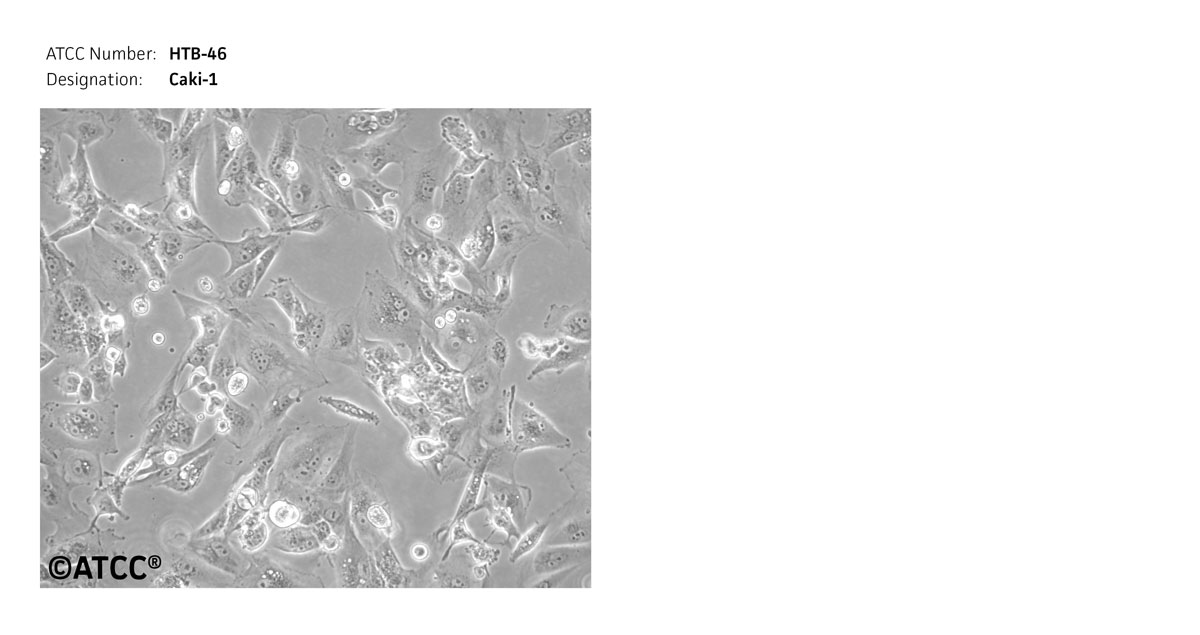
Frequently Asked Questions
References
Curated Citations
Fogh J. Human tumor cells in vitro. New York: Plenum Press; 1975.
Fogh J, et al. Absence of HeLa cell contamination in 169 cell lines derived from human tumors. J. Natl. Cancer Inst. 58: 209-214, 1977. PubMed: 833871
Goodfellow M, et al. One hundred and twenty-seven cultured human tumor cell lines producing tumors in nude mice. J. Natl. Cancer Inst. 59: 221-226, 1977. PubMed: 77210034
Pollack MS, et al. HLA-A, B, C and DR alloantigen expression on forty-six cultured human tumor cell lines. J. Natl. Cancer Inst. 66: 1003-1012, 1981. PubMed: 7017212
Fogh J. Cultivation, characterization, and identification of human tumor cells with emphasis on kidney, testis, and bladder tumors. Natl. Cancer Inst. Monogr. 49: 5-9, 1978. PubMed: 571047
 Powered by Bioz
For product-related inquiries and issues, contact Product Experience:


Hours of Operation
US Eastern Time
