
- Product category
-
Human cells
- Organism
-
Homo sapiens, human
- Morphology
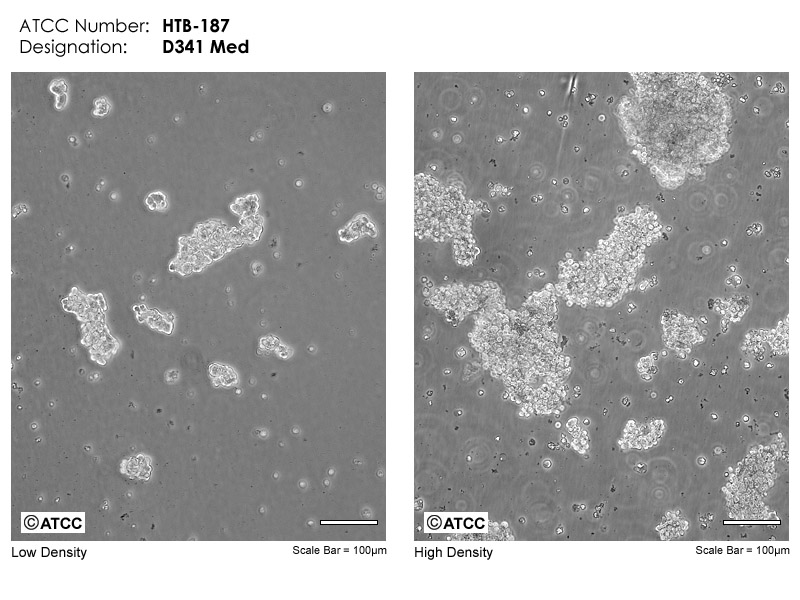
- spheroid
- Tissue
- Brain; Cerebellum
- Disease
-
Medulloblastoma
- Applications
-
3D cell cultureNeuroscience
- Product format
- Frozen
- Storage conditions
-
Vapor phase of liquid nitrogen
Documentation

ATCC determines the biosafety level of a material based on our risk assessment as guided by the current edition of Biosafety in Microbiological and Biomedical Laboratories (BMBL), U.S. Department of Health and Human Services. It is your responsibility to understand the hazards associated with the material per your organization’s policies and procedures as well as any other applicable regulations as enforced by your local or national agencies.
ATCC highly recommends that appropriate personal protective equipment is always used when handling vials. For cultures that require storage in liquid nitrogen, it is important to note that some vials may leak when submersed in liquid nitrogen and will slowly fill with liquid nitrogen. Upon thawing, the conversion of the liquid nitrogen back to its gas phase may result in the vial exploding or blowing off its cap with dangerous force creating flying debris. Unless necessary, ATCC recommends that these cultures be stored in the vapor phase of liquid nitrogen rather than submersed in liquid nitrogen.
Detailed product information
Characteristics
- Growth properties
- Suspension
- Derivation
-
The D341 Med cell line was established in 1988 by Friedman et al. from tumor tissue taken from a boy with medulloblastoma.
- Age
- 3.5 years
- Sex
- Male
- Karyotype
- This is a hyperdiploid (modal number = 49; range = 44 to 50) human cell line with higher ploidies occurring with a frequency of 8.5%. Four marker chromosomes are present in all cells. They are: 11HSR, i(17q), der(22)t(1;22)(q12;p12) and 8q-. There are three copies each of N6 and N18, and single copies each of N11, N17 and N22. The single X chromosome was structurally normal, and the presence of the Y chromosome was confirmed by fluorescence microsopy.
- Tumorigenic
-
Yes; Yes, in nude mice; forms serially transplantable intercranial and subcutaneous tumorsYes, in soft agar
- Genes expressed
- glutamine synthetase positive; neuron specific enolase positive; glial fibrillary acidic proteins negative; S100 (S-100) protein negative; neuroectodermal antigen positive, recognized by the UJ13A monoclonal antibody
- Comments
-
The cells produce tumors in nude mice.The cell line is positive for expression of neurofibrillary proteins, glutamine synthetase and neuron specific enolase but negative for glial fibrillary acidic proteins and S100 (S-100) protein.The cells are positive for the neuroectodermal antigen recognized by the UJ13A monoclonal antibody.The c-myc oncogene is amplified in D341 Med cells.
Handling information
- Unpacking and storage instructions
-
- Check all containers for leakage or breakage.
- Remove the frozen cells from the dry ice packaging and immediately place the cells at a temperature below -130°C, preferably in liquid nitrogen vapor, until ready for use.
- Complete medium
- The base medium for this cell line is ATCC-formulated Eagle's Minimum Essential Medium, Catalog No. 30-2003. To make the complete growth medium, add the following components to the base medium: fetal bovine serum to a final concentration of 20%.
- Temperature
-
37°C
- Handling procedure
-
To insure the highest level of viability, thaw the vial and initiate the culture as soon as possible upon receipt. If upon arrival, continued storage of the frozen culture is necessary, it should be stored in liquid nitrogen vapor phase and not at -70°C. Storage at -70°C will result in loss of viability.
- Thaw the vial by gentle agitation in a 37°C water bath. To reduce the possibility of contamination, keep the O-ring and cap out of the water. Thawing should be rapid (approximately 2 minutes).
- Remove the vial from the water bath as soon as the contents are thawed, and decontaminate by dipping in or spraying with 70% ethanol. All of the operations from this point on should be carried out under strict aseptic conditions.
- Transfer the vial contents to a centrifuge tube containing 9.0 mL complete culture medium. and spin at approximately 125 xg for 5 to7 minutes.
- Resuspend cell pellet with the recommended complete medium (see the specific batch information for the culture recommended dilution ratio) and dispense into a 25 cm2 culture flask. It is important to avoid excessive alkalinity of the medium during recovery of the cells. It is suggested that, prior to the addition of the vial contents, the culture vessel containing the complete growth medium be placed into the incubator for at least 15 minutes to allow the medium to reach its normal pH (7.0 to 7.6). pH (7.0 to 7.6).
- Incubate the culture at 37°C in a suitable incubator. A 5% CO2 in air atmosphere is recommended if using the medium described on this product
- Subculturing procedure
-
Cultures can be maintained by the addition of fresh medium. Cells grow mostly as floating aggregates of irregular-shaped cell clusters with some attached cells. Clusters are alive while single cells have very low viability. Attached cells can be shaken loose.Medium Renewal: 2 to 3 times per week
- Reagents for cryopreservation
- Culture medium, 90%; DMSO, 10%
Quality control specifications
- Mycoplasma contamination
- Not detected
- Population doubling time
- Approximately 37 hrs
- STR profiling
- Amelogenin: X,Y CSF1PO: 10,11 D13S317: 11,13 D16S539: 12,14 D5S818: 11,12 D7S820: 9,13 TH01: 6,9.3 TPOX: 8,11 vWA: 17,18 D3S1358: 16,18 D21S11: 30,31 D18S51: 12,17 Penta_E: 8,15 Penta_D: 9,13 D8S1179: 14 FGA: 19,23 D19S433: 13 D2S1338: 17
History
- Deposited as
- Homo sapiens
- Depositors
- HS Friedman
- Year of origin
- 1988
- Special collection
-
Human Tumor Cell Bank
Legal disclaimers
- Intended use
- This product is intended for laboratory research use only. It is not intended for any animal or human therapeutic use, any human or animal consumption, or any diagnostic use.
- Warranty
-
The product is provided 'AS IS' and the viability of ATCC® products is warranted for 30 days from the date of shipment, provided that the customer has stored and handled the product according to the information included on the product information sheet, website, and Certificate of Analysis. For living cultures, ATCC lists the media formulation and reagents that have been found to be effective for the product. While other unspecified media and reagents may also produce satisfactory results, a change in the ATCC and/or depositor-recommended protocols may affect the recovery, growth, and/or function of the product. If an alternative medium formulation or reagent is used, the ATCC warranty for viability is no longer valid. Except as expressly set forth herein, no other warranties of any kind are provided, express or implied, including, but not limited to, any implied warranties of merchantability, fitness for a particular purpose, manufacture according to cGMP standards, typicality, safety, accuracy, and/or noninfringement.
- Disclaimers
-
This product is intended for laboratory research use only. It is not intended for any animal or human therapeutic use, any human or animal consumption, or any diagnostic use. Any proposed commercial use is prohibited without a license from ATCC.
While ATCC uses reasonable efforts to include accurate and up-to-date information on this product sheet, ATCC makes no warranties or representations as to its accuracy. Citations from scientific literature and patents are provided for informational purposes only. ATCC does not warrant that such information has been confirmed to be accurate or complete and the customer bears the sole responsibility of confirming the accuracy and completeness of any such information.
This product is sent on the condition that the customer is responsible for and assumes all risk and responsibility in connection with the receipt, handling, storage, disposal, and use of the ATCC product including without limitation taking all appropriate safety and handling precautions to minimize health or environmental risk. As a condition of receiving the material, the customer agrees that any activity undertaken with the ATCC product and any progeny or modifications will be conducted in compliance with all applicable laws, regulations, and guidelines. This product is provided 'AS IS' with no representations or warranties whatsoever except as expressly set forth herein and in no event shall ATCC, its parents, subsidiaries, directors, officers, agents, employees, assigns, successors, and affiliates be liable for indirect, special, incidental, or consequential damages of any kind in connection with or arising out of the customer's use of the product. While reasonable effort is made to ensure authenticity and reliability of materials on deposit, ATCC is not liable for damages arising from the misidentification or misrepresentation of such materials.
Please see the material transfer agreement (MTA) for further details regarding the use of this product. The MTA is available at www.atcc.org.
Images
Frequently Asked Questions
References
Curated Citations
Friedman HS, et al. Phenotypic and genotypic analysis of a human meduloblastoma cell line and transplantable xenograft (D341 Med) demonstrating amplification of c-myc. Am. J. Pathol. 130: 472-484, 1988. PubMed: 3279793
He XM, et al. Expression of O6-methylguanine-DNA methyltransferase in six human medulloblastoma cell lines. Cancer Res. 52: 1144-1148, 1992. PubMed: 1737373
Rostomily RC, et al. Expression of neurogenic basic helix-loop-helix genes in primitive neuroectodermal tumors. Cancer Res. 57: 3526-3531, 1997. PubMed: 9270024
 Powered by Bioz
For product-related inquiries and issues, contact Product Experience:


Hours of Operation
US Eastern Time
