ATCC 100 Years Logo Anniversary ATCC 100 Years Logo Anniversary Cart 0
  • Quick Order
  • Careers
  • Support

CHLA-01-MED

CRL-3021

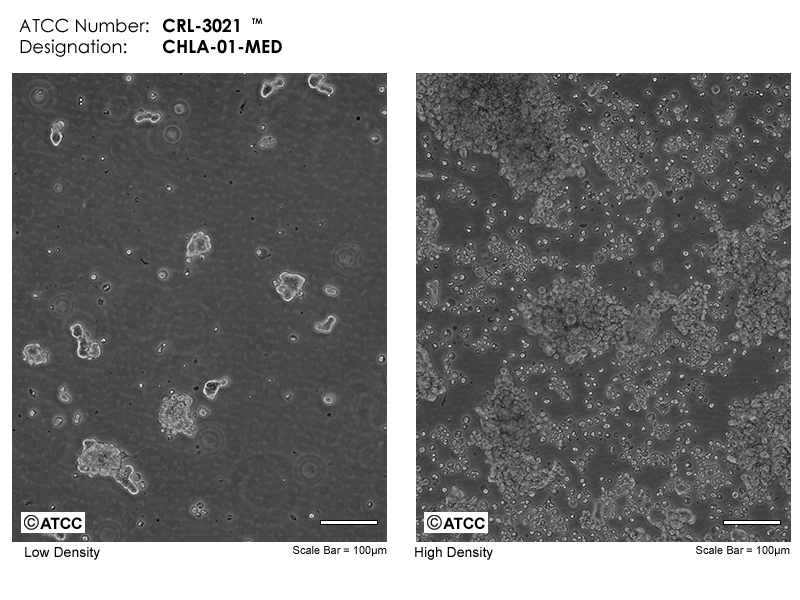
CHLA-01-MED is a cell line exhibiting rounded morphology that was isolated from the brain of an 8-year-old male with medulloblastoma. Cells were isolated from the brain tumor resected at the time of diagnosis and were cultured in neurobasal medium after mechanical disruption. This cell line was deposited by the Children's Hospital of Los Angeles and can be used in neuroscience research.
Product category
Human cells
Organism
Homo sapiens, human
Morphology
rounded
Tissue
Brain
Disease
Medulloblastoma
Applications
3D cell culture
Neuroscience
Product format
Frozen
Storage conditions
Vapor phase of liquid nitrogen
Buy Now
Price: $555.00 EA
Discounts may be available for our fellow nonprofit organizations. Login to see your price.

Generally ships within 1-3 business days

Documentation

ATCC determines the biosafety level of a material based on our risk assessment as guided by the current edition of Biosafety in Microbiological and Biomedical Laboratories (BMBL), U.S. Department of Health and Human Services. It is your responsibility to understand the hazards associated with the material per your organization’s policies and procedures as well as any other applicable regulations as enforced by your local or national agencies.

ATCC highly recommends that appropriate personal protective equipment is always used when handling vials. For cultures that require storage in liquid nitrogen, it is important to note that some vials may leak when submersed in liquid nitrogen and will slowly fill with liquid nitrogen. Upon thawing, the conversion of the liquid nitrogen back to its gas phase may result in the vial exploding or blowing off its cap with dangerous force creating flying debris. Unless necessary, ATCC recommends that these cultures be stored in the vapor phase of liquid nitrogen rather than submersed in liquid nitrogen.

Required Products

These products are vital for the proper use of this item and have been confirmed as effective in supporting functionality. If you use alternative products, the quality and effectiveness of the item may be affected.

Detailed product information

Characteristics

Growth properties
Suspension, single cells and clusters
Derivation

CHLA-01-MED was established from an 8 year old boy with CNS-disseminated medulloblastoma. Cells were isolated from the brain tumor resected at the time of diagnosis and were cultured in neurobasal medium after mechanical disruption. This cell line has been continuously carried in culture for over 18 months, and in neurobasal medium grows as spheres of varying sizes. When placed in medium containing fetal bovine serum the cells attach and spread, but after a period of proliferation they senesce.

A metastatic recurrent medulloblastoma cell line from this patient is available as CHLA-01R-MED (see ATCC CRL-3034)

Age
8 years
Gender
Male
Karyotype
This is a human male cell line with a chromosome range of 42∼46. The karyotype contained two consistent chromosome rearrangements, der(17)t(1;17)(q11;q25) and der(18)(17;18)(q11.2;p11.2) and approximately 40% of the examined metaphase spreads contained 11∼16 double minutes.
Comments

CHLA-01-MED was established from an 8 year old boy with CNS-disseminated medulloblastoma. Cells were isolated from the brain tumor resected at the time of diagnosis and were cultured in neurobasal medium after mechanical disruption. This cell line has been continuously carried in culture for over 18 months, and in neurobasal medium grows as spheres of varying sizes. When placed in medium containing fetal bovine serum the cells attach and spread, but after a period of proliferation they senesce. The generation of this cell line was made possible with the support of the Michael Hoefflin Foundation for Children's Cancer to Childrens Hospital Los Angeles, with the goal of making pediatric brain tumor lines available to the research community.

A metastatic recurrent medulloblastoma cell line from this patient is available as CHLA-01R-MED (see ATCC CRL-3034)

Handling information

Unpacking and storage instructions
  1. Check all containers for leakage or breakage.
  2. Remove the frozen cells from the dry ice packaging and immediately place the cells at a temperature below ­-130°C, preferably in liquid nitrogen vapor, until ready for use.
Complete medium

DMEM:F12 Medium (ATCC 30-2006) with 20 ng/mL human recombinant EGF, 20 ng/mL human recombinant basic FGF, and B-27 Supplement (Invitrogen, Cat. No.17504) to a final concentration of 2% (v/v)

Media preparation:

Note: Because of limited stability, the following components should be added to an aliquot of the above culture medium fresh prior to seeding or performing fluid additions. Complete medium with the below components is stable for 10 days in culture.

  • B27 Supplement (Gibco catalog # 17504-044): use 20 uL per 1 mL culture medium
    Note: Remaining B27 should be aliquoted and stored at -20"C
    Aliquots should not be subjected to more than 2 freeze/thaws.
  • 20 ug/mL EGF: use 1 uL per 1 mL culture medium
    To prepare 20 pg/1 mL EGF stock solution, aseptically combine: 
    • 100 pg Gibco EGF (ThermoFisher Scientific catalog # PHG0311) or equivalent
    • 1 mL PBS (ATCC 30-2200)
    • Then further dilute by adding:
    • 4 mL PBS/0.1% BSA
     
  • 20 ug/mL basic FGF: use 1 uL per 1 mL culture medium
    To prepare 20 pg/1 mLbasic FGF stock solution, aseptically combine:
    • 100 pg GibcorM basic FGF (ThermoFisher Scientific catalog # PHG0021) or equivalent
    • 1 mL sterile water (ATCC 60-2450)
      Then further dilute by adding:
    • 4 mL PBS/0.1% BSA
Temperature
37°C
Atmosphere
95% Air, 5% CO2
Handling procedure

To insure the highest level of viability, thaw the vial and initiate the culture as soon as possible upon receipt. If upon arrival, continued storage of the frozen culture is necessary, it should be stored in liquid nitrogen vapor phase and not at –70°C.  Storage at –70°C will result in loss of viability.

Comments:  

On the Certificate of Analysis, it is reported that these cells tend to grow in aggregates that may lose viability when they are dispersed. Accurate counts and viabilities may not be possible. 

Cells may be slow to recover from cryopreservation and may take 7-10 days to begin actively growing.

  1. Thaw the vial by gentle agitation in a 37°C water bath. To reduce the possibility of contamination, keep the O-ring and cap out of the water.  Thawing should be rapid (approximately 2 minutes).
  2. Remove the vial from the water bath as soon as the contents are thawed, and decontaminate by dipping in or spraying with 70% ethanol. All of the operations from this point on should be carried out under strict aseptic conditions.
  3. Transfer the vial contents to a centrifuge tube containing 9.0 mL complete culture medium and spin at approximately 150 to 400 x g; 8 to 12 minutes (200 x g for 8 minutes). 
  4. Resuspend cell pellet with the recommended complete growth medium (see the lot information on Certificate of Analysis (COA) for the culture recommended dilution ratio) and dispense into a 25 cm2 or a 75 cm2 culture flask as recommended on the COA.  The recommended seeding dilution for CRL-3021 is 1:10. Counting cells is not recommended. It is important to avoid excessive alkalinity of the medium during recovery of the cells.  It is suggested that, prior to the addition of the vial contents, the culture vessel containing the complete growth medium be placed into the incubator for at least 15 minutes to allow the medium to reach its normal pH (7.0 to 7.6).
  5. Incubate the culture at 37°C in a suitable incubator.  A 5% CO2 in air atmosphere is recommended if using the medium described on this product.
Subculturing procedure
  • Subculture when there are numerous, healthy appearing clusters present in suspension
  • Addition of culture medium
  • Full fluid changes: Full fluid changes must be performed at  least every 10 days or before the medium becomes too acidic as follows:
  • Transfer cells to a centrifuge tube and centrifuge cell suspension into a pellet. 
  • Aspirate supernatant.
  • Resuspend in a small volume of fresh pre-warmed culture medium and gently disperse cells by pipetting using a serological pipette.
  • Transfer cell suspension into a new flask with additional fresh growth media to bring the cell suspension up to the desired volume.
  • Fluid additions may be performed between full fluid changes as needed.
Note: Due to large, tight clusters formed by these cells, it may be difficult to accurately measure cell number and viability.

Subcultivation ratio: A subcultivation ratio of 1:2 to 1:3 is recommended.

Medium renewal: Add fresh medium every 4 to 7 days (depending on cell density).
Reagents for cryopreservation
Reagents for cryopreservation: 50% FBS + 50% Cell Freezing Medium (Sigma catalog # C6295-50ML)

Quality control specifications

Mycoplasma contamination
Not detected
STR profiling
Amelogenin: X,Y
CSF1PO: 11
D13S317: 8,14
D16S539: 9,11
D5S818: 11,13
D7S820: 10
TH01: 6,9.3
TPOX: 9,12
vWA: 16,17
D3S1358: 16,17
D21S11: 27,29
D18S51: 13,17
Penta_E: 14,19,20
Penta_D: 11,14
D8S1179: 13
FGA: 22,25
D19S433: 15
D2S1338: 18,24

History

Depositors
Anat Erdreich-Epstein, Saban Research Institute, Childrens Hospital Los Angeles

Legal disclaimers

Intended use
This product is intended for laboratory research use only. It is not intended for any animal or human therapeutic use, any human or animal consumption, or any diagnostic use.
Warranty

The product is provided 'AS IS' and the viability of ATCC® products is warranted for 30 days from the date of shipment, provided that the customer has stored and handled the product according to the information included on the product information sheet, website, and Certificate of Analysis. For living cultures, ATCC lists the media formulation and reagents that have been found to be effective for the product. While other unspecified media and reagents may also produce satisfactory results, a change in the ATCC and/or depositor-recommended protocols may affect the recovery, growth, and/or function of the product. If an alternative medium formulation or reagent is used, the ATCC warranty for viability is no longer valid.  Except as expressly set forth herein, no other warranties of any kind are provided, express or implied, including, but not limited to, any implied warranties of merchantability, fitness for a particular purpose, manufacture according to cGMP standards, typicality, safety, accuracy, and/or noninfringement.

Disclaimers

This product is intended for laboratory research use only. It is not intended for any animal or human therapeutic use, any human or animal consumption, or any diagnostic use. Any proposed commercial use is prohibited without a license from ATCC.

While ATCC uses reasonable efforts to include accurate and up-to-date information on this product sheet, ATCC makes no warranties or representations as to its accuracy. Citations from scientific literature and patents are provided for informational purposes only. ATCC does not warrant that such information has been confirmed to be accurate or complete and the customer bears the sole responsibility of confirming the accuracy and completeness of any such information.

This product is sent on the condition that the customer is responsible for and assumes all risk and responsibility in connection with the receipt, handling, storage, disposal, and use of the ATCC product including without limitation taking all appropriate safety and handling precautions to minimize health or environmental risk. As a condition of receiving the material, the customer agrees that any activity undertaken with the ATCC product and any progeny or modifications will be conducted in compliance with all applicable laws, regulations, and guidelines. This product is provided 'AS IS' with no representations or warranties whatsoever except as expressly set forth herein and in no event shall ATCC, its parents, subsidiaries, directors, officers, agents, employees, assigns, successors, and affiliates be liable for indirect, special, incidental, or consequential damages of any kind in connection with or arising out of the customer's use of the product. While reasonable effort is made to ensure authenticity and reliability of materials on deposit, ATCC is not liable for damages arising from the misidentification or misrepresentation of such materials.

Please see the material transfer agreement (MTA) for further details regarding the use of this product. The MTA is available at www.atcc.org.

Permits & Restrictions

Import Permit for the State of Hawaii

If shipping to the U.S. state of Hawaii, you must provide either an import permit or documentation stating that an import permit is not required. We cannot ship this item until we receive this documentation. Contact the Hawaii Department of Agriculture (HDOA), Plant Industry Division, Plant Quarantine Branch to determine if an import permit is required.

MORE INFORMATION ABOUT PERMITS AND RESTRICTIONS

Frequently Asked Questions

References

For product-related inquiries and issues, contact Product Experience:

Message Us

Hours of Operation

Monday - Friday
9:00am - 5:00pm
US Eastern Time