
- Clone type
- Vector
- Applications
-
Molecular biology
- Product format
- Frozen
- Storage conditions
-
-80°C or colder
Documentation

ATCC determines the biosafety level of a material based on our risk assessment as guided by the current edition of Biosafety in Microbiological and Biomedical Laboratories (BMBL), U.S. Department of Health and Human Services. It is your responsibility to understand the hazards associated with the material per your organization’s policies and procedures as well as any other applicable regulations as enforced by your local or national agencies.
Detailed product information
General
- Specific applications
-
Counterselection levansucrase
Suicide vector
Vector permitting allelic exchange of cloned inserts
Characteristics
- Comments
-
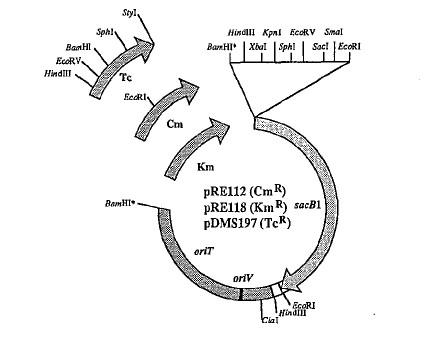
The sacB1 allele is a variant of sacB with certain restriction sites removed by site directed mutagenesis. Expression of sacB confers sensitivity to sucrose.
The conditional R6K origin of replication requires that the pi protein be expressed in trans for plasmid maintenance.
One of four allelic exchange suicide vectors (ATCC 87691 - 87694) that provide both selection for chromosomal integration (ampR, cmlR, kanR or tetR) and counterselection for loss of vector DNA and the wild type allele.
Construct is suicide plasmid in any host not expressing pir.
Cloned inserts may be integrated into the host chromosome (a single recombination event) following electroporation and appropriate antibiotic selection.
Negative selection for sucrose sensitivity (sacB) selects for a second recombination event resulting in loss of vector DNA. - Mycoplasma contamination
- Not detected
Vector information
- Vector name
- pRE118 (plasmid)
- Type of vector
- plasmid
- Construction
- pRE107, kanR (pUC71-K)
- Vector information
-
Selectable Marker: Kanamycin resistantMarker: kanR, sacB1 (Mol Microbiol 18, 1995)
- Cloning sites
-
XbaI; KpnI; SphI; EcoRV; SacI; SmaI; EcoRI
- Markers
-
sacB; kanR
- Replicon
- conditional R6K; oriT
Insert information
- Target gene
-
levansucrase
Handling information
- Medium
- Temperature
-
37°C
History
- Depositors
- DM Schifferli
- Special collection
-
NCRR Contract
Legal disclaimers
- Intended use
- This product is intended for laboratory research use only. It is not intended for any animal or human therapeutic use, any human or animal consumption, or any diagnostic use.
- Warranty
-
The product is provided 'AS IS' and the viability of ATCC® products is warranted for 30 days from the date of shipment, provided that the customer has stored and handled the product according to the information included on the product information sheet, website, and Certificate of Analysis. For living cultures, ATCC lists the media formulation and reagents that have been found to be effective for the product. While other unspecified media and reagents may also produce satisfactory results, a change in the ATCC and/or depositor-recommended protocols may affect the recovery, growth, and/or function of the product. If an alternative medium formulation or reagent is used, the ATCC warranty for viability is no longer valid. Except as expressly set forth herein, no other warranties of any kind are provided, express or implied, including, but not limited to, any implied warranties of merchantability, fitness for a particular purpose, manufacture according to cGMP standards, typicality, safety, accuracy, and/or noninfringement.
- Disclaimers
-
This product is intended for laboratory research use only. It is not intended for any animal or human therapeutic use, any human or animal consumption, or any diagnostic use. Any proposed commercial use is prohibited without a license from ATCC.
While ATCC uses reasonable efforts to include accurate and up-to-date information on this product sheet, ATCC makes no warranties or representations as to its accuracy. Citations from scientific literature and patents are provided for informational purposes only. ATCC does not warrant that such information has been confirmed to be accurate or complete and the customer bears the sole responsibility of confirming the accuracy and completeness of any such information.
This product is sent on the condition that the customer is responsible for and assumes all risk and responsibility in connection with the receipt, handling, storage, disposal, and use of the ATCC product including without limitation taking all appropriate safety and handling precautions to minimize health or environmental risk. As a condition of receiving the material, the customer agrees that any activity undertaken with the ATCC product and any progeny or modifications will be conducted in compliance with all applicable laws, regulations, and guidelines. This product is provided 'AS IS' with no representations or warranties whatsoever except as expressly set forth herein and in no event shall ATCC, its parents, subsidiaries, directors, officers, agents, employees, assigns, successors, and affiliates be liable for indirect, special, incidental, or consequential damages of any kind in connection with or arising out of the customer's use of the product. While reasonable effort is made to ensure authenticity and reliability of materials on deposit, ATCC is not liable for damages arising from the misidentification or misrepresentation of such materials.
Please see the material transfer agreement (MTA) for further details regarding the use of this product. The MTA is available at www.atcc.org.
Images
Frequently Asked Questions
References
Curated Citations
Edwards RA, et al. Improved allelic exchange vectors and their use to analyze 987P fimbria gene expression. Gene 207: 149-157, 1998. PubMed: 9511756
Kolter R, et al. Trans-complementation-dependent replication of a low molecular weight origin fragment from plasmid R6K. Cell 15: 1199-1208, 1978. PubMed: 728998
Donnenberg MS, Kaper JB. Construction of an eae deletion mutant of enteropathogenic Escherichia coli by using a positive-selection suicide vector. Infect. Immun. 59: 4310-4317, 1991. PubMed: 1937792
Blomfield IC, et al. Allelic exchange in Escherichia coli using the Bacillus subtilis sacB gene and a temperature-sensitive pSC101 replicon. Mol. Microbiol. 5: 1447-1457, 1991. PubMed: 1686293
McIver KS, et al. The elastase propeptide functions as an intramolecular chaperone required for elastase activity and secretion in Pseudomonas aeruginosa. Mol. Microbiol. 18: 877-889, 1995. PubMed: 8825092
 Powered by Bioz
For product-related inquiries and issues, contact Product Experience:


Hours of Operation
US Eastern Time
