
- Product category
-
Viruses
- Product type
-
Animal virus
- Classification
- Adenoviridae, Mastadenovirus, Human adenovirus B
- Strain designation
- Compton
- Genome sequenced strain
- Yes
- Isolation source
- Human urine.
- Applications
-
Infectious disease researchRespiratory disease research
- Product format
- Frozen
- Storage conditions
-
-70°C or colder
Documentation

ATCC determines the biosafety level of a material based on our risk assessment as guided by the current edition of Biosafety in Microbiological and Biomedical Laboratories (BMBL), U.S. Department of Health and Human Services. It is your responsibility to understand the hazards associated with the material per your organization’s policies and procedures as well as any other applicable regulations as enforced by your local or national agencies.
ATCC highly recommends that appropriate personal protective equipment is always used when handling vials. For cultures that require storage in liquid nitrogen, it is important to note that some vials may leak when submersed in liquid nitrogen and will slowly fill with liquid nitrogen. Upon thawing, the conversion of the liquid nitrogen back to its gas phase may result in the vial exploding or blowing off its cap with dangerous force creating flying debris. Unless necessary, ATCC recommends that these cultures be stored in the vapor phase of liquid nitrogen rather than submersed in liquid nitrogen.
Detailed product information
General
- Specific applications
-
Respiratory research
Characteristics
- Comments
-
The virus has been placed in Rosen's HA group 1, subgroup 1a. No HAI or SN cross with types 1 through 33; high HAI cross between AV-34 virus and AV-35 sera; moderate HAI cross between AV-35 cirus and AV-34 sera.The adenovirion, with typical morphology and CF and HA activities, has a buoyant density of 1.340 g/ml; average diameter, excluding projections is 73 nm. Partially heat labile at pH 7.0 with or without 1 M MgCl[2].The virus has been placed in Rosen's HA group 1, subgroup 1a. No HAI or SN cross with types 1 through 33; high HAI cross between AV-34 virus and AV-35 sera; moderate HAI cross between AV-35 cirus and AV-34 sera.
- Mycoplasma contamination
- Not detected
Handling information
- Host
-
HEp-2 (ATCC CCL-23)Host Range: WI-38 (ATCC CCL-75), HELF, RU-1, Pr HAm, Pr HEK, KB (ATCC CCL-17), HEp-2 (ATCC CCL-23)
- Effects
-
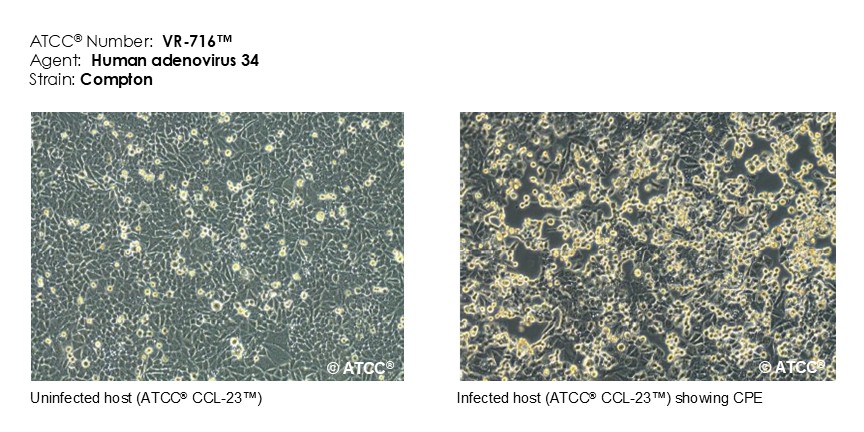
cell sloughing; cell detachment; cell clumping; refractile cell rounding
- Complete medium
- EMEM +10% FBS
- Temperature
-
35°C
- Incubation
- 3 days
- Recommendation for infection
-
- Seed cells at 3.0-5.0x10⁴ cells/cm2 to achieve 70-80% confluence at time of infection (1 – 2 days after seeding)
- Rinse cells with 1X DPBS or Neat EMEM
- Agent should be diluted using Neat EMEM with a virus MOI of 0.014
- Adsorption is at 37°C, 50% CO2, humidity for 1 – 2 hours. Vessels should be stationary
- AGM is EMEM + 2% FBS
- Recommended incubation time is 2 – 4 days.
- Harvest once vessels at 80 – 90% CPE presentation.
- Handling notes
-
This virus has been placed in Rosens HA group 1, subgroup 1a. No HAI or SN cross with types 1 through 33; high HAI cross between AV-34 virus and AV-35 sera; moderate HAI cross between AV-35 virus and AV-34 sera. The adenovirion, with typical morphology and CF and HA activities, has a buoyant density of 1.340 g/mL; average diameter, excluding projections is 73 nm. Partially heat labile at pH 7.0 with or without 1 M MgCl2.
- Key abbreviations
-
°C, Degrees CelsiusCO2, Carbon dioxideEMEM, Eagle's Minimum Essential MediumFBS, Fetal bovine serumMOI, Multiplicity of infection
Quality control specifications
- Volume
- 1.0 mL
- Verification method
-
Whole-genome Sequencing
History
- Deposited as
- Adenovirus type 34
- Depositors
- JC Hierholzer
- Type of isolate
- Human
- Year of origin
- 1972
- Cross references
-
GenBank U52571 Human adenovirus type 34 virus-associated RNA pre-terminal protein (pTP) and 52,55K protein genes, partial cds.
Legal disclaimers
- Intended use
- This product is intended for laboratory research use only. It is not intended for any animal or human therapeutic use, any human or animal consumption, or any diagnostic use.
- Warranty
-
The product is provided 'AS IS' and the viability of ATCC® products is warranted for 30 days from the date of shipment, provided that the customer has stored and handled the product according to the information included on the product information sheet, website, and Certificate of Analysis. For living cultures, ATCC lists the media formulation and reagents that have been found to be effective for the product. While other unspecified media and reagents may also produce satisfactory results, a change in the ATCC and/or depositor-recommended protocols may affect the recovery, growth, and/or function of the product. If an alternative medium formulation or reagent is used, the ATCC warranty for viability is no longer valid. Except as expressly set forth herein, no other warranties of any kind are provided, express or implied, including, but not limited to, any implied warranties of merchantability, fitness for a particular purpose, manufacture according to cGMP standards, typicality, safety, accuracy, and/or noninfringement.
- Disclaimers
-
This product is intended for laboratory research use only. It is not intended for any animal or human therapeutic use, any human or animal consumption, or any diagnostic use. Any proposed commercial use is prohibited without a license from ATCC.
While ATCC uses reasonable efforts to include accurate and up-to-date information on this product sheet, ATCC makes no warranties or representations as to its accuracy. Citations from scientific literature and patents are provided for informational purposes only. ATCC does not warrant that such information has been confirmed to be accurate or complete and the customer bears the sole responsibility of confirming the accuracy and completeness of any such information.
This product is sent on the condition that the customer is responsible for and assumes all risk and responsibility in connection with the receipt, handling, storage, disposal, and use of the ATCC product including without limitation taking all appropriate safety and handling precautions to minimize health or environmental risk. As a condition of receiving the material, the customer agrees that any activity undertaken with the ATCC product and any progeny or modifications will be conducted in compliance with all applicable laws, regulations, and guidelines. This product is provided 'AS IS' with no representations or warranties whatsoever except as expressly set forth herein and in no event shall ATCC, its parents, subsidiaries, directors, officers, agents, employees, assigns, successors, and affiliates be liable for indirect, special, incidental, or consequential damages of any kind in connection with or arising out of the customer's use of the product. While reasonable effort is made to ensure authenticity and reliability of materials on deposit, ATCC is not liable for damages arising from the misidentification or misrepresentation of such materials.
Please see the material transfer agreement (MTA) for further details regarding the use of this product. The MTA is available at www.atcc.org.
Images
Frequently Asked Questions
References
Curated Citations
Hierholzer JC, et al. New human adenovirus isolated from a renal transplant recipient: description and characterization of candiate adenovirus type 34. J. Clin. Microbiol. 1: 366-376, 1975. PubMed: 170313
Hierholzer JC, et al. Antigenic relationships among the 47 human adenoviruses determined in reference horse antisera. Arch. Virol. 121: 179-197, 1991. PubMed: 1759904
Ma Y, Mathews MB. Structure, function, and evolution of adenovirus-associated RNA: a phylogenetic approach. J. Virol. 70: 5083-5099, 1996. PubMed: 8764016
 Powered by Bioz
For product-related inquiries and issues, contact Product Experience:


Hours of Operation
US Eastern Time
