
- Applications
-
Molecular biology
- Product format
- Frozen
- Shipping information
- Escherichia coli HB101 stocks containing the plasmid arrayed on a microtiter plate
- Storage conditions
-
-80°C or colder
Documentation

ATCC determines the biosafety level of a material based on our risk assessment as guided by the current edition of Biosafety in Microbiological and Biomedical Laboratories (BMBL), U.S. Department of Health and Human Services. It is your responsibility to understand the hazards associated with the material per your organization’s policies and procedures as well as any other applicable regulations as enforced by your local or national agencies.
ATCC highly recommends that appropriate personal protective equipment is always used when handling vials. For cultures that require storage in liquid nitrogen, it is important to note that some vials may leak when submersed in liquid nitrogen and will slowly fill with liquid nitrogen. Upon thawing, the conversion of the liquid nitrogen back to its gas phase may result in the vial exploding or blowing off its cap with dangerous force creating flying debris. Unless necessary, ATCC recommends that these cultures be stored in the vapor phase of liquid nitrogen rather than submersed in liquid nitrogen.
Detailed product information
General
- Specific applications
-
This is a set of 15 marker swap vectors, each containing a gene disruption conversion cassette for conversion between standard markers used for transformation selection in Saccharomyces cerevisiae. The vectors are useful in changing markers for gene disruptions or for changing markers on plasmids.
To convert the host phenotype from the existing yeast auxotrophic marker to a new marker (eg. HIS3 → LEU2), transform with the restriction enzyme digested vector (eg. ApaI+PstI digested pHL3) and select for the appropriate phenotype (for pHL3, Leu+).
Some combinations of marker swap plasmids and target locus may result in relatively high reversion rates. In most, but not all cases, the frequencies of successful convertants are greater than 30%. When swapping markers on an episomal plasmid, appropriate phenotype may result from loss of the plasmid unless a second selectable or scorable marker is used to ensure plasmid maintenance.
Characteristics
- Comments
-
Some combinations of marker swap plasmids and target locus may result in relatively high reversion rates. In most but not all cases the frequencies of successful convertants are greater than 30%.
A set of marker swap vectors, containing gene disruptions for standard markers such as his3::LEU2, useful in changing markers in the S. cerevisiae host chromosome or on plasmids.
The set allows interconversion among all six of the common markers HIS3, LEU2, TRP1, URA3, ADE2, and LYS2.
To convert the host phenotype from the existing yeast auxotrophic marker to a new marker (eg. HIS3 → LEU2), transform with the restriction enzyme digested vector (eg. ApaI+PstI digested pHL3) and select for the appropriate phenotype (for pHL3, Leu+).
When swapping markers on an episomal plasmid, appropriate phenotype may result from loss of the plasmid unless a second selectable or scorable marker is used to ensure plasmid maintenance.
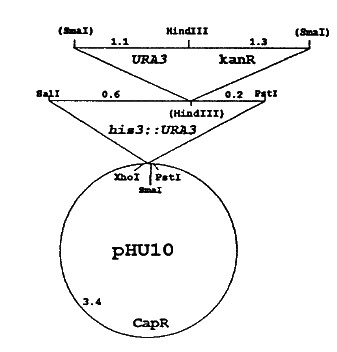
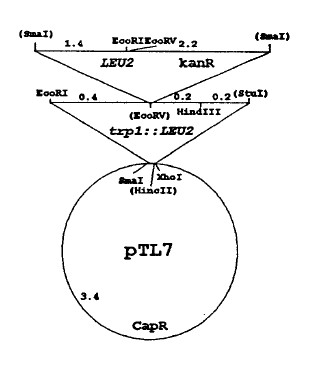
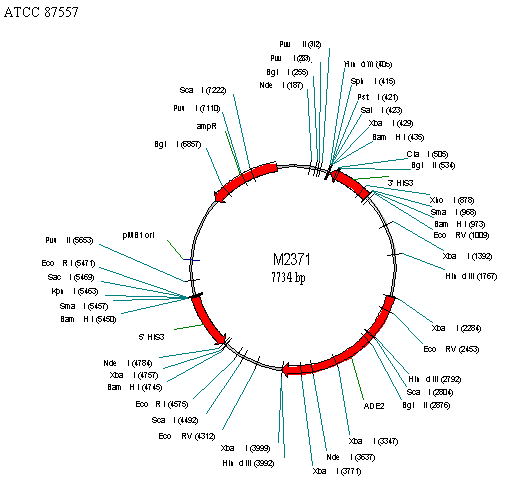
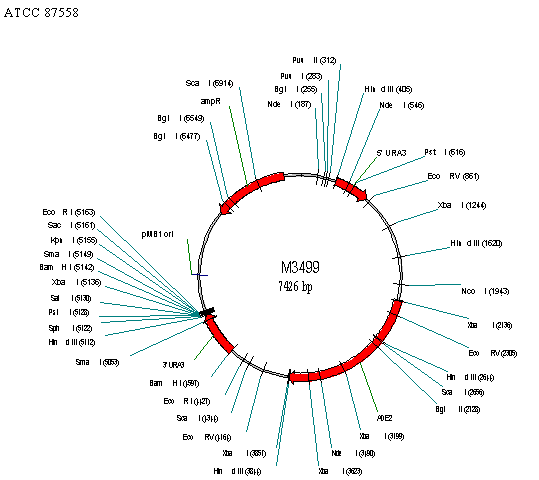
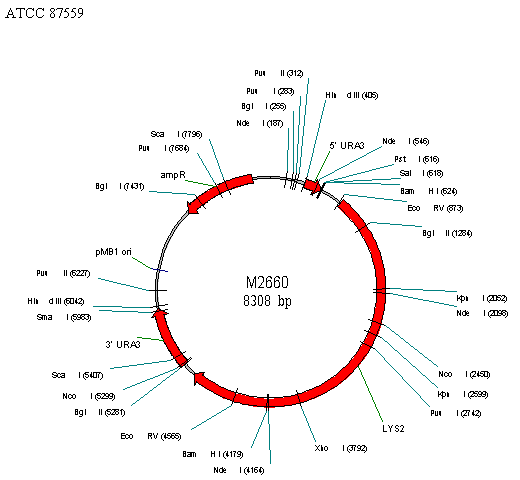
Maps for some of the vectors can be found on the ATCC web page or in the reference. Vectors are all in E. coli and arrayed on a microtiter plate.
A key to the plate is provided below.
Well
Name
ATCC
Convert Function
Enzymes to Excise
size
Markers
a1
pHL3
87542
HIS3 →LEU2
ApaI+PstI
4.3
cmlR LEU2
a2
pHT6
87543
HIS3 →TRP1
SmaI+XhoI
3.6
cmlR kanR TRP1
a3
pHU10
87544
HIS3 →URA3
SmaI+XhoI
3.2
cmlR kanR URA3
a4
pLH7
87545
LEU2 →HIS3
XhoI+HpaI
4.3
cmlR kanR HIS3
a5
pLT11
87546
LEU2 →TRP1
XhoI+HpaI
6.1
ampR cmlR TRP1
a6
pLU12
87547
LEU2 →URA3
XhoI+HpaI
4.1
cmlR kanR URA3
a7
pTH4
87548
TRP1 →HIS3
XhoI+EcoRI
3.3
cmlR kanR HIS3
a8
pTL7
87549
TRP1 →LEU2
XhoI+SmaI
4.4
cmlR kanR LEU2
a9
pTU10
87550
TRP1 →URA3
XhoI+EcoRI
3.2
cmlR kanR URA3
a10
pUH7
87551
URA3 →HIS3
SmaI
3.5
ampR kanR HIS3
a11
pUL9
87552
URA3 →LEU2
SmaI
4.6
ampR kanR LEU2
a12
pUT11
87553
URA3 →TRP1
SmaI
3.7
ampR kanR TRP1
b1
M2371
87557
HIS →ADE2
PstI+SacI
4.99
ampR ADE2
b2
M3499
87558
URA3 →ADE2
PstI
4.45
ampR ADE2
b3
M2660
87559
URA3 →LYS2
HindIII
5.57
ampR LYS2
Handling information
- Handling procedure
- Transfer a loopful to a test tube containing 5 mL LB+ antibiotic (either 50 µg/mL of ampicillin 10 µg/mL chloramphenicol or 25 µg/mL chloramphenicol and 50 µg/mL kanamycin check specific markers). A loopful of culture can also be streaked on an LB + amp or chl agar plate. Incubate cultures at 37°C. Isolate DNA using standard plasmid preparation procedures.
- Handling notes
-
To convert the host phenotype from the existing yeast auxotrophic marker to a new marker (eg. HIS3 → LEU2), transform with the restriction enzyme digested vector (eg. ApaI+PstI digested pHL3) and select for the appropriate phenotype (for pHL3, Leu+).
Some combinations of marker swap plasmids and target locus may result in relatively high reversion rates. In most, but not all cases, the frequencies of successful convertants are greater than 30%. When swapping markers on an episomal plasmid, appropriate phenotype may result from loss of the plasmid unless a second selectable or scorable marker is used to ensure plasmid maintenance.
Refer to reference for more information.
- Yeast 13: 647-653, 1997
History
- Depositors
- FR Cross, DJ Stillman
- Special collection
-
NCRR Contract
Legal disclaimers
- Intended use
- This product is intended for laboratory research use only. It is not intended for any animal or human therapeutic use, any human or animal consumption, or any diagnostic use.
- Warranty
-
The product is provided 'AS IS' and the viability of ATCC® products is warranted for 30 days from the date of shipment, provided that the customer has stored and handled the product according to the information included on the product information sheet, website, and Certificate of Analysis. For living cultures, ATCC lists the media formulation and reagents that have been found to be effective for the product. While other unspecified media and reagents may also produce satisfactory results, a change in the ATCC and/or depositor-recommended protocols may affect the recovery, growth, and/or function of the product. If an alternative medium formulation or reagent is used, the ATCC warranty for viability is no longer valid. Except as expressly set forth herein, no other warranties of any kind are provided, express or implied, including, but not limited to, any implied warranties of merchantability, fitness for a particular purpose, manufacture according to cGMP standards, typicality, safety, accuracy, and/or noninfringement.
- Disclaimers
-
This product is intended for laboratory research use only. It is not intended for any animal or human therapeutic use, any human or animal consumption, or any diagnostic use. Any proposed commercial use is prohibited without a license from ATCC.
While ATCC uses reasonable efforts to include accurate and up-to-date information on this product sheet, ATCC makes no warranties or representations as to its accuracy. Citations from scientific literature and patents are provided for informational purposes only. ATCC does not warrant that such information has been confirmed to be accurate or complete and the customer bears the sole responsibility of confirming the accuracy and completeness of any such information.
This product is sent on the condition that the customer is responsible for and assumes all risk and responsibility in connection with the receipt, handling, storage, disposal, and use of the ATCC product including without limitation taking all appropriate safety and handling precautions to minimize health or environmental risk. As a condition of receiving the material, the customer agrees that any activity undertaken with the ATCC product and any progeny or modifications will be conducted in compliance with all applicable laws, regulations, and guidelines. This product is provided 'AS IS' with no representations or warranties whatsoever except as expressly set forth herein and in no event shall ATCC, its parents, subsidiaries, directors, officers, agents, employees, assigns, successors, and affiliates be liable for indirect, special, incidental, or consequential damages of any kind in connection with or arising out of the customer's use of the product. While reasonable effort is made to ensure authenticity and reliability of materials on deposit, ATCC is not liable for damages arising from the misidentification or misrepresentation of such materials.
Please see the material transfer agreement (MTA) for further details regarding the use of this product. The MTA is available at www.atcc.org.
Images
Frequently Asked Questions
References
Curated Citations
Cross FR. 'Marker swap' plasmids: convenient tools for budding yeast molecular genetics. Yeast 13: 647-653, 1997. PubMed: 9200814
 Powered by Bioz
For product-related inquiries and issues, contact Product Experience:


Hours of Operation
US Eastern Time
