
- Organism
-
Saccharomyces cerevisiae Meyen ex E.C. Hansen
- Classification
- Saccharomycetes, Saccharomycetidae, Saccharomycetales, Saccharomycetaceae, Saccharomycetaceae, Saccharomyces, cerevisiae
- Clone type
- Clone
- Applications
-
Molecular biology
- Product format
- Freeze-dried
- Shipping information
- Escherichia coli containing the phagemid
- Storage conditions
-
2°C to 8°C
Documentation

ATCC determines the biosafety level of a material based on our risk assessment as guided by the current edition of Biosafety in Microbiological and Biomedical Laboratories (BMBL), U.S. Department of Health and Human Services. It is your responsibility to understand the hazards associated with the material per your organization’s policies and procedures as well as any other applicable regulations as enforced by your local or national agencies.
Detailed product information
General
- Specific applications
-
produces protein alpha-1,2-mannosyltransferase
Characteristics
- Comments
-
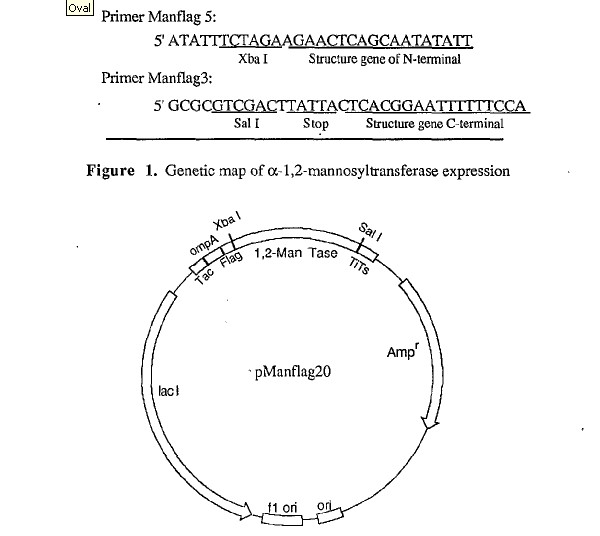
Restriction digests of the clone give the following sizes (kb): XbaI/SalI--5.4, 1.3; EcoRI--6.3, 0.3, 0.2; BglII--6.8; HindIII--6.3, 0.3, 0.2; BamHI--6.8.The insert contains the following restriction sites (approximate kb from the 5' end): EcoRI--0.13, 0.41; HindIII--0.28; NcoI--0.16, 0.23, 0.78; PvuI--0.21; XmnI--1.22.Purification of the protein (all steps at 4C): Centrifuge 5 l of induced E. coli cells at 10,000 g for 10 min.Decant supernatant. Resuspend pellet in 200 ml of [20% sucrose, 10mM Tris-HCl pH 7.6]. Add 4 ml of 0.5 M EDTA and incubate on ice for 30 min. Centrifuge 5 min. Decant supernatant.Resuspend pellet in 20 ml cold distilled water. Incubate on ice for 30 min. Centrifuge 5 min. Carefully remove and save the supernatant, containing the periplasmic fraction.Slowly add 1 ml of [2 M Tris-HCl, 100 mM CaCl2.]. Incubate on ice for 10 minutes. Centrifuge 5 min. Dialyze supernatant 8 hr at 0C in 100 mM Tris-HCl, pH 7.6.Induce protein production using 0.005 mM IPTG for 12 hours at 30C (for proper protein folding and secretion into the periplasm).The insert corresponds to the coding sequence for the catalytic domain of the protein (nt 547-1782 of the sequence record).It was constructed by amplification from yeast DNA using primers incorporating XbaI (5') and SalI (3') sites: upstream 5'-ATATTTCTAGAAGAACTCAGCAATATATT-3' and downstream 5'-GCGCGTCGACTTATTACTCACGGAATTTTTTCCA-3'.Cell growth and gene induction: Grow to mid-log phase in M9 plus 2% casamino acids containing 1 mM CaCl2 and 100 ug/ml ampicillin at 37C.The order of the major features of this phagemid is: pMB1 ori - f1 ori - lacI - tac promoter - ompA - flag - XbaI/insert/SalI - rrnB terminator - ampR.
- Mycoplasma contamination
- Not detected
- Technical information
-
ATCC Product Experience does not have technical information on patent deposits that are not produced or characterized by ATCC. Additional information can be found in the corresponding patent available from the patent holder or with the U.S. and/or international patent office.
Vector information
- Construct size (kb)
- 6.800000190734863
Insert information
- Insert size (kb)
- 1.3999999999999999
- Type of DNA
- genomic
- Target gene
-
alpha-1,2-mannosyltransferase
- Gene product
- alpha-1,2-mannosyltransferase [MNT1]
- Insert end
-
3ʹ SalI; 5ʹ XbaI
Handling information
- Medium
- Temperature
-
37°C
- Handling procedure
-
Grow cells to mid-log phase in M9 + 2% casamino acids containing 1 mM CaCl2 and 100 mg/mL ampicillin at 37°C. Induce protein production using 0.005 mM IPTG for 12 hours at 30°C (for proper protein folding and secretion into the periplasm).
- Handling notes
-
Restriction digests of the clone gave the following sizes (in kb): XbaI/SalI 5.4, 1.3; HindIII 6.3, 0.3, 0.2; EcoRI 6.3, 0.3, 0.2 ; Bgl II 6.8 ; BamHI 6.8. ATCC Staff
History
- Depositors
- C Wong
- Patent depository
-
This material was deposited with the ATCC Patent Depository to fulfill U.S. or international patent requirements. This material may not have been produced or characterized by ATCC. As an International Depository Authority (IDA) for patent deposits, ATCC is required to complete viability testing only at time of initial deposit of patent material. Patent deposits are made available on behalf of the Depositor when the pertinent U.S. or international patent is issued, but material may not be used to infringe the patent claims.
- Patent number
-
6,485,930
- Cross references
-
GenBank M81110
Legal disclaimers
- Intended use
- This product is intended for laboratory research use only. It is not intended for any animal or human therapeutic use, any human or animal consumption, or any diagnostic use.
- Warranty
-
The product is provided 'AS IS' and the viability of ATCC® products is warranted for 30 days from the date of shipment, provided that the customer has stored and handled the product according to the information included on the product information sheet, website, and Certificate of Analysis. For living cultures, ATCC lists the media formulation and reagents that have been found to be effective for the product. While other unspecified media and reagents may also produce satisfactory results, a change in the ATCC and/or depositor-recommended protocols may affect the recovery, growth, and/or function of the product. If an alternative medium formulation or reagent is used, the ATCC warranty for viability is no longer valid. Except as expressly set forth herein, no other warranties of any kind are provided, express or implied, including, but not limited to, any implied warranties of merchantability, fitness for a particular purpose, manufacture according to cGMP standards, typicality, safety, accuracy, and/or noninfringement.
- Disclaimers
-
This product is intended for laboratory research use only. It is not intended for any animal or human therapeutic use, any human or animal consumption, or any diagnostic use. Any proposed commercial use is prohibited without a license from ATCC.
While ATCC uses reasonable efforts to include accurate and up-to-date information on this product sheet, ATCC makes no warranties or representations as to its accuracy. Citations from scientific literature and patents are provided for informational purposes only. ATCC does not warrant that such information has been confirmed to be accurate or complete and the customer bears the sole responsibility of confirming the accuracy and completeness of any such information.
This product is sent on the condition that the customer is responsible for and assumes all risk and responsibility in connection with the receipt, handling, storage, disposal, and use of the ATCC product including without limitation taking all appropriate safety and handling precautions to minimize health or environmental risk. As a condition of receiving the material, the customer agrees that any activity undertaken with the ATCC product and any progeny or modifications will be conducted in compliance with all applicable laws, regulations, and guidelines. This product is provided 'AS IS' with no representations or warranties whatsoever except as expressly set forth herein and in no event shall ATCC, its parents, subsidiaries, directors, officers, agents, employees, assigns, successors, and affiliates be liable for indirect, special, incidental, or consequential damages of any kind in connection with or arising out of the customer's use of the product. While reasonable effort is made to ensure authenticity and reliability of materials on deposit, ATCC is not liable for damages arising from the misidentification or misrepresentation of such materials.
Please see the material transfer agreement (MTA) for further details regarding the use of this product. The MTA is available at www.atcc.org.
- Disclosures
-
This material is cited in a US and/or international patent and may not be used to infringe the claims. Depending on the wishes of the Depositor, ATCC may be required to inform the Depositor of the party to which the material was furnished.
Images
Frequently Asked Questions
References
Curated Citations
Wang P, et al. Enzymes in oligosaccharide synthesis: active-domain overproduction, specificity study and synthetic use of an alpha-1,2-mannosyltransferase with regeneration of GDP-Man. J. Org. Chem. : submitted, 1993.
 Powered by Bioz
For product-related inquiries and issues, contact Product Experience:


Hours of Operation
US Eastern Time
