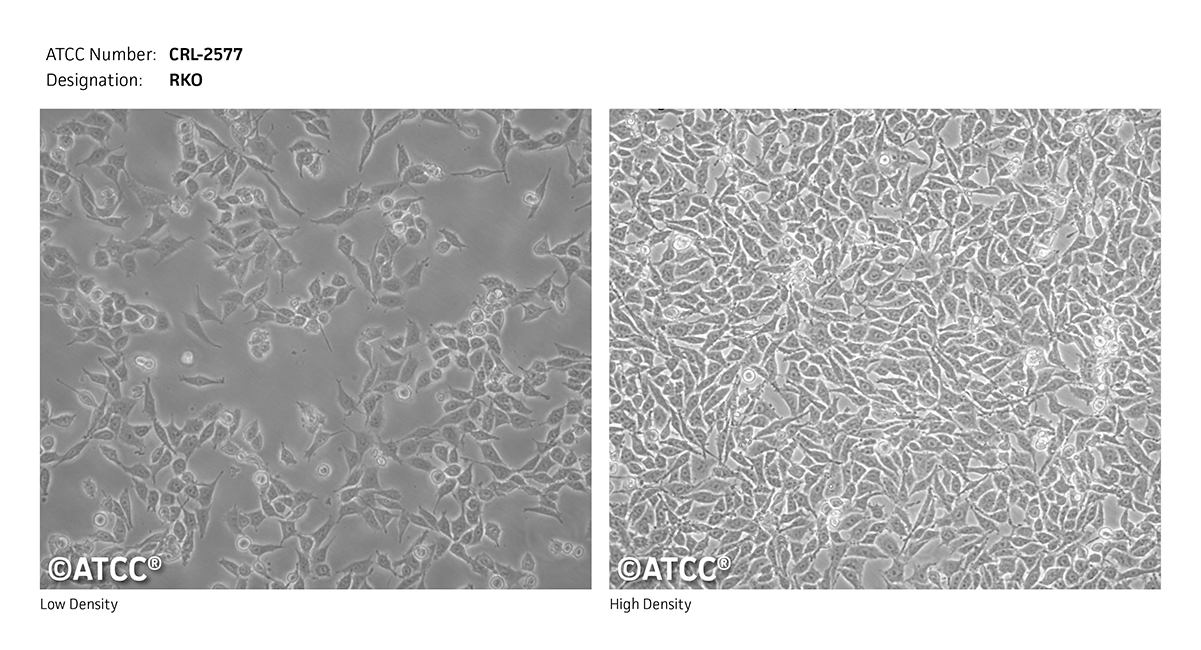
RKO (ATCC® CRL-2577)

Organism: Homo sapiens, human  /  Tissue: colon  / 

Permits Notice: Necessary Permits

These permits may be required for shipping this product:

  • Customers located in the state of Hawaii will need to contact the Hawaii Department of Agriculture to determine if an Import Permit is required. A copy of the permit or documentation that a permit is not required must be sent to ATCC in advance of shipment.
Organism Homo sapiens, human
Tissue
colon
Product Format frozen
Morphology epithelial
Culture Properties adherent
Biosafety Level 1
Disease Carcinoma
Applications
It can be used as the control cell line for investigating the effects of p53 and gadd45 on cellular parameters.
Derivation
RKO is a poorly differentiated colon carcinoma cell line developed by Michael Brattain.
Receptor Expression
urokinase receptor (u-PAR)
Oncogene p53 + (wild type) RefSmith ML, et al. Involvement of the p53 tumor suppressor in repair of u.v.-type DNA damage. Oncogene 10: 1053-1059, 1995. PubMed: 7700629
Genes Expressed
p53 + (wild type)
Tumorigenic Yes
Comments

RKO cells contain wild-type p53 but lack endogenous human thyroid receptor nuclear receptor (h-TRbeta1). The level of p53 protein is higher in RKO (ATCC CRL-2577) cells than in RKO-E6 (ATCC CRL-2578) cells.

The RKO cell line is the parental cell line (isogenic) of RKO-E6 (ATCC CRL-2578) and RKO-A545-1 (ATCC CRL-2579).
Complete Growth Medium The base medium for this cell line is ATCC-formulated Eagle's Minimum Essential Medium, Catalog No. 30-2003. To make the complete growth medium, add the following components to the base medium: fetal bovine serum to a final concentration of 10%.
Subculturing
Subcultivation Ratio: A subcultivation ratio of 1:3 to 1:12 is recommended
Medium Renewal: Every 2 to 3 days
Remove medium, and rinse with 0.25% trypsin, 0.03% EDTA solution. Remove the solution and add an additional 1 to 2 mL of trypsin-EDTA solution. Allow the flask to sit at room temperature (or at 37°C) until the cells detach. Add fresh culture medium, aspirate and dispense into new culture flasks.
Cryopreservation
culture medium 95%; DMSO, 5%
Culture Conditions
Temperature: 37°C

Atmosphere: air, 95%; carbon dioxide (CO2), 5%
STR Profile
Amelogenin: X
CSF1PO: 8, 10
D13S317: 8, 11
D16S539: 12, 13
D5S818: 11, 13
D7S820: 8, 10
THO1: 6, 10
TPOX:11
vWA: 15, 16, 17
Name of Depositor MC Hollander, AJ Fornace
References

Boyd D, et al. Determination of the levels of urokinase and its receptor in human colon carcinoma cell lines. Cancer Res. 48: 3112-3116, 1988. PubMed: 2835152

Smith ML, et al. Involvement of the p53 tumor suppressor in repair of u.v.-type DNA damage. Oncogene 10: 1053-1059, 1995. PubMed: 7700629

Brattain MG, et al. Heterogeneity of human colon carcinoma. Cancer Metastasis Rev. 3: 177-191, 1984. PubMed: 6437669

Bhat MK, et al. Tumor suppressor p53 is a negative regulator in thyroid hormone receptor signaling pathways. J. Biol. Chem. 272: 28989-28993, 1997. PubMed: 9360971

Smith ML, et al. Involvement of the p53 tumor suppressor in repair of u.v.-type DNA damage. Oncogene 10: 1053-1059, 1995. PubMed: 7700629

Permits Notice: Necessary Permits

These permits may be required for shipping this product:

  • Customers located in the state of Hawaii will need to contact the Hawaii Department of Agriculture to determine if an Import Permit is required. A copy of the permit or documentation that a permit is not required must be sent to ATCC in advance of shipment.
Basic Documentation
Other Documentation
References

Boyd D, et al. Determination of the levels of urokinase and its receptor in human colon carcinoma cell lines. Cancer Res. 48: 3112-3116, 1988. PubMed: 2835152

Smith ML, et al. Involvement of the p53 tumor suppressor in repair of u.v.-type DNA damage. Oncogene 10: 1053-1059, 1995. PubMed: 7700629

Brattain MG, et al. Heterogeneity of human colon carcinoma. Cancer Metastasis Rev. 3: 177-191, 1984. PubMed: 6437669

Bhat MK, et al. Tumor suppressor p53 is a negative regulator in thyroid hormone receptor signaling pathways. J. Biol. Chem. 272: 28989-28993, 1997. PubMed: 9360971

Smith ML, et al. Involvement of the p53 tumor suppressor in repair of u.v.-type DNA damage. Oncogene 10: 1053-1059, 1995. PubMed: 7700629