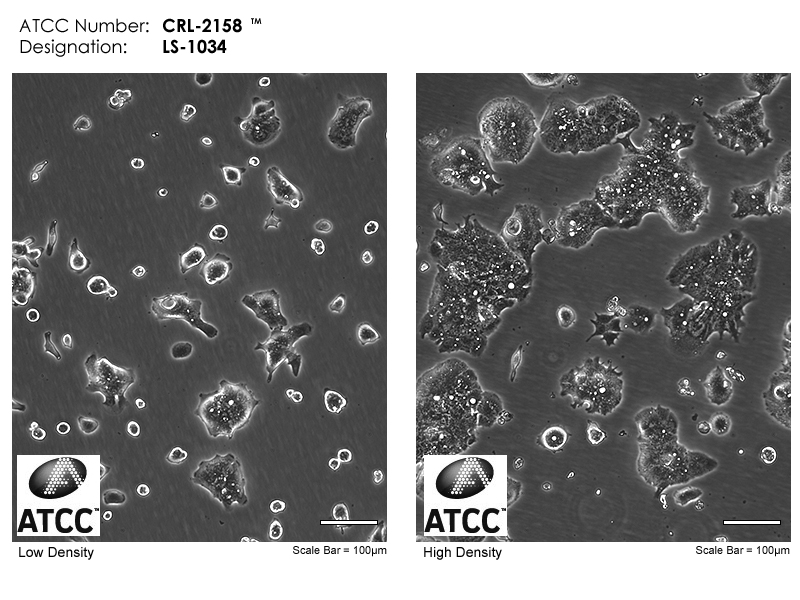
LS1034 (ATCC® CRL-2158)

Organism: Homo sapiens, human  /  Tissue: Cecum  / 

Permits Notice: Necessary Permits

These permits may be required for shipping this product:

  • Customers located in the state of Hawaii will need to contact the Hawaii Department of Agriculture to determine if an Import Permit is required. A copy of the permit or documentation that a permit is not required must be sent to ATCC in advance of shipment.
Organism Homo sapiens, human
Tissue Cecum
Product Format frozen
Morphology epithelial
Culture Properties adherent, adherent
Biosafety Level 1
Disease Dukes' type C, colorectal carcinoma
Age 54 years
Gender male
Ethnicity Caucasian
Storage Conditions liquid nitrogen vapor phase
Karyotype modal number = 77, YY; seven markers involving chromosomes 1, 7, 14, X, and 18 were recognized. The other chromosomes involved could not be properly identified.; Monosomy 7 and monosomy 14 were present in all 15 metaphases analyzed. No normal chromosomes 5 or 18 were observed.
Images
Derivation
LS1034 is a colorectal carcinoma cell line isolated in 1989 from a primary tumor biopsy from a 54-year old Caucasian male patient diagnosed with Dukes' Type C, moderately to poorly differentiated cecal carcinoma.
Clinical Data
54 years
Caucasian
Antigen Expression
carcinoembryonic antigen (CEA); ICAM-1; HLA class I positive
Oncogene p53 + (mutated, Gly --> Ser mutation at position 245), APC (mutated, deletion, GAAAAGATT --> GATT at codon 1309)
Genes Expressed
p53 + (mutated, Gly --> Ser mutation at position 245), APC (mutated, deletion, GAAAAGATT --> GATT at codon 1309),carcinoembryonic antigen (CEA); ICAM-1; HLA class I positive
Tumorigenic Yes
Comments
More than 90% of LS1034 cells express surface CEA.
The cells express the major histocompatibility (MHC) class I antigens and beta 2 microglobulin, but class II antigens, (HLA-DR, DQ, and DP) were not detected.
No measurable amount of latent transforming growth factor beta-1 (TGF beta-1) is secreted.
Picomolar concentrations of TGF beta-1, TGF beta-2, and TGF beta-3 inhibit the proliferation of LS1034 cells.
LS1034 cells are multidrug resistant (MDR), and can proliferate in serum free medium.
The patient did not exhibit familial adenomatous polyposis (FAP) and normal tissue did not have the deletion in the APC gene.
The colony forming efficiency was 3% in methylcellulose medium containing 5% fetal bovine serum, and the clonogenicity is increased 600% in serum free methylcellulose as compared to semisolid medium containing serum.
A culture submitted to the ATCC in September 1994 was found to be contaminated with mycoplasma, and was cured by a 21 day treatment with BM Cycline.
Complete Growth Medium The base medium for this cell line is ATCC-formulated RPMI-1640 Medium, Catalog No. 30-2001. To make the complete growth medium, add the following components to the base medium: fetal bovine serum to a final concentration of 10%.
Subculturing
Protocol:
  1. Remove and discard culture medium.
  2. Briefly rinse the cell layer with 0.25% (w/v) Trypsin- 0.53 mM EDTA solution to remove all traces of serum that contains trypsin inhibitor.
  3. Add 2.0 to 3.0 mL of Trypsin-EDTA solution to flask and observe cells under an inverted microscope until cell layer is dispersed (usually within 5 to 15 minutes).
    Note: To avoid clumping do not agitate the cells by hitting or shaking the flask while waiting for the cells to detach. Cells that are difficult to detach may be placed at 37°C to facilitate dispersal.
  4. Add 6.0 to 8.0 mL of complete growth medium and aspirate cells by gently pipetting.
  5. Add appropriate aliquots of the cell suspension to new culture vessels.
  6. Incubate cultures at 37°C.
    Subcultivation Ratio: A subcultivation ratio of 1:3 is recommended
    Medium Renewal: Twice per week
    Cryopreservation
    Freeze Medium: Complete growth medium supplemented with 5% (v/v) DMSO
    Storage Temperature: Liquid nitrogen vapor phase
    Culture Conditions
    Temperature: 37°C
    STR Profile
    Amelogenin: X,Y
    CSF1PO: 11,12
    D13S317: 12
    D16S539: 9,11
    D5S818: 12,13
    D7S820: 8,12
    THO1: 7
    TPOX: 9,11
    vWA: 17
    Population Doubling Time 33 hrs
    Name of Depositor L Suardet
    Year of Origin 1989
    References

    Suardet L, et al. Responsiveness of three newly established human colorectal cancer cell lines to transforming growth factors beta 1 and beta 2. Cancer Res. 52: 3705-3712, 1992. PubMed: 1617643

    Burmester JK, et al. Characterization of distinct functional domains of transforming growth factor beta. Proc. Natl. Acad. Sci. USA 90: 8628-8632, 1993. PubMed: 7690965

    Li CY, et al. Potential role of WAF1/Cip1/p21 as a mediator of TGF-beta cytoinhibitory effect. J. Biol. Chem. 270: 4971-4974, 1995. PubMed: 7890601

    Cottrell S, et al. Molecular analysis of APC mutations in familial adenomatous polyposis and sporadic colon carcinomas. Lancet 340: 626-630, 1992. PubMed: 1355210

    Permits Notice: Necessary Permits

    These permits may be required for shipping this product:

    • Customers located in the state of Hawaii will need to contact the Hawaii Department of Agriculture to determine if an Import Permit is required. A copy of the permit or documentation that a permit is not required must be sent to ATCC in advance of shipment.
    Basic Documentation
    Other Documentation
    References

    Suardet L, et al. Responsiveness of three newly established human colorectal cancer cell lines to transforming growth factors beta 1 and beta 2. Cancer Res. 52: 3705-3712, 1992. PubMed: 1617643

    Burmester JK, et al. Characterization of distinct functional domains of transforming growth factor beta. Proc. Natl. Acad. Sci. USA 90: 8628-8632, 1993. PubMed: 7690965

    Li CY, et al. Potential role of WAF1/Cip1/p21 as a mediator of TGF-beta cytoinhibitory effect. J. Biol. Chem. 270: 4971-4974, 1995. PubMed: 7890601

    Cottrell S, et al. Molecular analysis of APC mutations in familial adenomatous polyposis and sporadic colon carcinomas. Lancet 340: 626-630, 1992. PubMed: 1355210