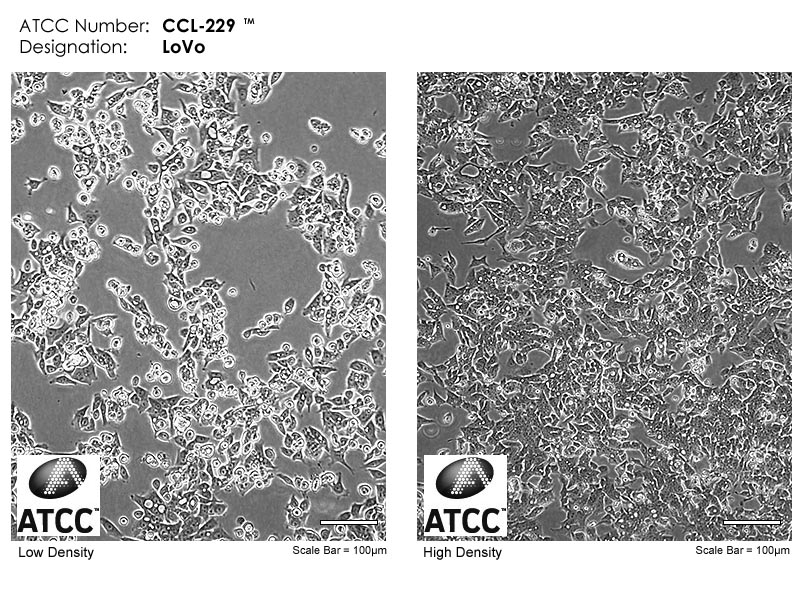
LoVo (ATCC® CCL-229)

Organism: Homo sapiens, human  /  Tissue: colon, derived from left supraclavicular region metastasis.  / 

Permits Notice: Necessary Permits

These permits may be required for shipping this product:

  • Customers located in the state of Hawaii will need to contact the Hawaii Department of Agriculture to determine if an Import Permit is required. A copy of the permit or documentation that a permit is not required must be sent to ATCC in advance of shipment.
Organism Homo sapiens, human
Tissue
colon, derived from left supraclavicular region metastasis.
Product Format frozen
Morphology epithelial
Culture Properties adherent
Biosafety Level 1
Disease Dukes' type C, grade IV,colorectal adenocarcinoma
Age 56 years
Gender male
Applications
This cell line is a suitable transfection host.
Karyotype The stemline chromosome number is hyperdiploid with the 2S component occurring at about 2.7% and 3 marker chromosomes were common to all S metaphases. Karyotypes were generally homogeneous and stable.
Images
Derivation
LoVo was initiated in 1971 from a fragment of a metastatic tumor nodule in the left supraclavicular region of a 56-year-old Caucasian male patient with a histologically proven diagnosis of adenocarcinoma of the colon.
Clinical Data
male
Antigen Expression
HLA A11, B15, B17, Cw1, Cw3; blood type B
Oncogene myc +; myb + ; ras +; fos +; p53 +; sis -; abl -; ros -; src -
Genes Expressed
carcinoembryonic antigen (CEA) 908 ng/10 exp6 cells/10 days,myc +; myb + ; ras +; fos +; p53 +; sis -; abl -; ros -; src -,HLA A11, B15, B17, Cw1, Cw3; blood type B,The cells are negative for expression of CSAp (CSAp-) and colon antigen 3.,The line is positive for expression of c-myc, K-ras, H-ras, N-ras, Myb, sis and fos oncogenes.
Tumorigenic Yes
Comments
The cells are negative for expression of CSAp (CSAp-) and colon antigen 3.

The line is positive for expression of c-myc, K-ras, H-ras, N-ras, Myb, sis and fos oncogenes.

N-myc and sis oncogene expression were not detected.

Tumor specific nuclear matrix proteins CC-3 and CC-4 are expressed.

Complete Growth Medium The base medium for this cell line is ATCC-formulated F-12K Medium, Catalog No. 30-2004. To make the complete growth medium, add the following components to the base medium: fetal bovine serum to a final concentration of 10%.
Subculturing
Subcultivation Ratio: A subcultivation ratio of 1:3 to 1:10 is recommended
Medium Renewal: 2 to 3 times per week
Remove medium, and rinse with 0.25% trypsin, 0.03% EDTA solution. Remove the solution and add an additional 1 to 2 mL of trypsin-EDTA solution. Allow the flask to sit at room temperature (or at 37°C) until the cells detach.
Add fresh culture medium, aspirate and dispense into new culture flasks.
Cryopreservation
culture medium 95%; DMSO, 5%
Culture Conditions
Temperature: 37°C
STR Profile
Amelogenin: XY
CSF1PO: 10,11,13,14
D13S317: 8, 11
D16S539: 9, 12
D5S818: 11, 12, 13
D7S820: 9.3,10, 11
THO1: 9.3
TPOX: 8,9
vWA: 17,18
Isoenzymes
ES-D, 1
G6PD, B
PGD, A
PGM1, 2
PGM3, 1-2
Name of Depositor M Romsdahl
Year of Origin 1971
References

Drewinko B, et al. Further biologic characteristics of a human carcinoembryonic antigen-producing colon carcinoma cell line. J. Natl. Cancer Inst. 61: 75-83, 1978. PubMed: 276641

Drewinko B, Yand LY. Restriction of CEA synthesis to the stationary phase of growth of cultured human colon carcinoma cells. Exp. Cell Res. 101: 414-416, 1976. PubMed: 964319

Drewinko B, et al. Establishment of a human carcinoembryonic antigen-producing colon adenocarcinoma cell line. Cancer Res. 36: 467-475, 1976. PubMed: 1260746

Trainer DL, et al. Biological characterization and oncogene expression in human colorectal carcinoma cell lines. Int. J. Cancer 41: 287-296, 1988. PubMed: 3338874

Keesee SK, et al. Nuclear matrix proteins in human colon cancer. Proc. Natl. Acad. Sci. USA 91: 1913-1916, 1994. PubMed: 8127905

Drewinko B, et al. Response of exponentially growing, stationary-phase, and synchronized cultured human colon carcinoma cells to treatment with nitrosourea derivatives. Cancer Res. 39: 2630-2636, 1979. PubMed: 445465

Miranda L, et al. Isolation of the human PC6 gene encoding the putative host protease for HIV-1 gp160 processing in CD4+ T lymphocytes. Proc. Natl. Acad. Sci. USA 93: 7695-7700, 1996. PubMed: 8755538

Tumors developed within 21 days at 100% frequency (5/5) in nude mice inoculated subcutaneously with 10(7) cells

Cross References

Nucleotide (GenBank) : X17097 Human PSG9 mRNA for pregnancy specific glycoprotein 9.

Nucleotide (GenBank) : X17098 Human PSG10 mRNA for pregnancy specific glycoprotein 10.

Nucleotide (GenBank) : X14831 Human mRNA for transmembrane carcinoembryonic antigen BGPb (formerly TM2-CEA).

Permits Notice: Necessary Permits

These permits may be required for shipping this product:

  • Customers located in the state of Hawaii will need to contact the Hawaii Department of Agriculture to determine if an Import Permit is required. A copy of the permit or documentation that a permit is not required must be sent to ATCC in advance of shipment.
Basic Documentation
Other Documentation
References

Drewinko B, et al. Further biologic characteristics of a human carcinoembryonic antigen-producing colon carcinoma cell line. J. Natl. Cancer Inst. 61: 75-83, 1978. PubMed: 276641

Drewinko B, Yand LY. Restriction of CEA synthesis to the stationary phase of growth of cultured human colon carcinoma cells. Exp. Cell Res. 101: 414-416, 1976. PubMed: 964319

Drewinko B, et al. Establishment of a human carcinoembryonic antigen-producing colon adenocarcinoma cell line. Cancer Res. 36: 467-475, 1976. PubMed: 1260746

Trainer DL, et al. Biological characterization and oncogene expression in human colorectal carcinoma cell lines. Int. J. Cancer 41: 287-296, 1988. PubMed: 3338874

Keesee SK, et al. Nuclear matrix proteins in human colon cancer. Proc. Natl. Acad. Sci. USA 91: 1913-1916, 1994. PubMed: 8127905

Drewinko B, et al. Response of exponentially growing, stationary-phase, and synchronized cultured human colon carcinoma cells to treatment with nitrosourea derivatives. Cancer Res. 39: 2630-2636, 1979. PubMed: 445465

Miranda L, et al. Isolation of the human PC6 gene encoding the putative host protease for HIV-1 gp160 processing in CD4+ T lymphocytes. Proc. Natl. Acad. Sci. USA 93: 7695-7700, 1996. PubMed: 8755538

Tumors developed within 21 days at 100% frequency (5/5) in nude mice inoculated subcutaneously with 10(7) cells